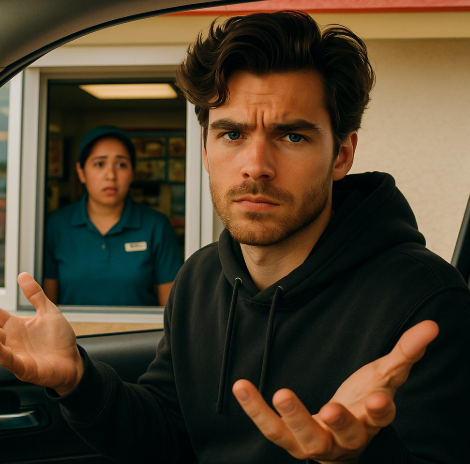
I pulled up to the drive-thru window in a hoodie that cost more than their register float and smiled like I owned the joint—because spiritually, I did.
“Hey, I had a coupon for a free sandwich that I didn’t get to use. It expired yesterday, but I still want it,” I said.
The cashier blinked. “Um… sir, it’s expired.”
“And yet,” I said, gesturing vaguely to the cosmos, “I’m still hungry.”
She hesitated. “We… can’t honor it.”
“So you admit,” I leaned closer, “you had every intention of feeding me. You printed the coupon. You mailed it. You promised me food. And then what? You pull the rug at the eleventh hour? That’s fraud. Emotional distress. Economic sabotage.”
Her manager stepped into view. “Sir, I—”
“Save it. I’m not asking for the sandwich anymore. I’m demanding $7.49 plus interest for the time I’ve spent emotionally preparing to eat something I never got. That’s psychological theft.”
I didn’t get the sandwich.
But I did get banned.
Lesson learned? Never underestimate the value of expired paper when Hot Josh is hungry. Justice has no expiration date.
So, this happened when I was about 26. I had just finished screaming into a pillow over a $14.99 charge for something that clearly should’ve been on sale, and I decided to treat myself to a little something nice. I walked into this trendy local shop that sells overpriced candles, ironic mugs, and throw pillows with phrases like “Live. Laugh. Lawsuit.”
Anyway, I walk up to the counter with my haul: two mugs (one said “CEO of Entitlement”, obviously), a crystal that allegedly absorbs negativity (spoiler: it didn’t), and a blanket that felt like it was woven from the dreams of unemployed influencers.
When the clerk rang it all up, I casually dropped: “Can you apply the employee discount?”
She squinted at me like I had just told her I was Batman. “Do you work here?” she asked, with the dead-eyed optimism of someone who’s been asked if the bathroom is for customers only… eight times that day.
I said, “Not technically, but I did help unload boxes once when your delivery guy almost fell over. I basically saved your whole operation.”
She blinked. “That was six months ago.”
“Exactly. Loyalty like that deserves recognition,” I said, flashing my most dazzling, legally-distinct-from-a-real-celebrity smile.
She offered me a 10% discount… Off one item.
I said, “That’s a joke, right?” She said, “No, that’s a mercy.”
I bought nothing. Told her I’d take my business to someone who respects unpaid volunteers. Like Costco. Or possibly the Salvation Army.
LESSON LEARNED: Apparently “vibes” and “once did a favor” don’t qualify as legal forms of employment. Who knew?
I had just installed the most expensive pergola the city of Scottsdale had ever seen — an arched, stained cedar masterpiece crowned with UV-treated canvas sails and recessed lighting that dimmed like a Parisian rooftop bar. Naturally, the HOA hated it.
At first, they claimed it “didn’t conform to the community aesthetic,” which I found rich coming from a board whose own president had plastic flamingos in her yard. But the final straw came when I received a formal violation for casting shadows.
“Your pergola is obstructing natural sunlight to the neighbor’s yard between 4:15 and 5:25 PM,” the letter read. “Please rectify or remove the structure.”
Excuse me? Rectify the position of the SUN? No. No, I don’t think I will.
I attended the next HOA meeting in full aviators and a suit. I brought charts. I brought a sun path calculator. I brought a laser pointer. I demanded that the HOA evict the sun if it couldn’t get its act together and shine at a more accommodating angle.
I also suggested installing a community mirror system to bounce light where needed. “It’s either that,” I said, “or I take this to the Department of Cosmic Affairs.”
One board member snorted. I turned to him and asked, “Do you think shadows are a joke, Greg?”
They fined me anyway. $500 per day until I removed the pergola. So I compromised:
I left the pergola up and covered it in mirrors.
Now it reflects sunlight into every backyard on the block. Directly. Blindingly. It’s like a lighthouse in suburbia. My house can now be seen from planes. Birds crash into it. Kids think it’s a portal.
They dropped the fine within 48 hours.
🧠 What I learned:
HOAs are the kind of people who tell you to mow your rocks and repaint invisible fences. You can’t reason with them. You have to out-crazy them — with science, spectacle, and solar defiance.
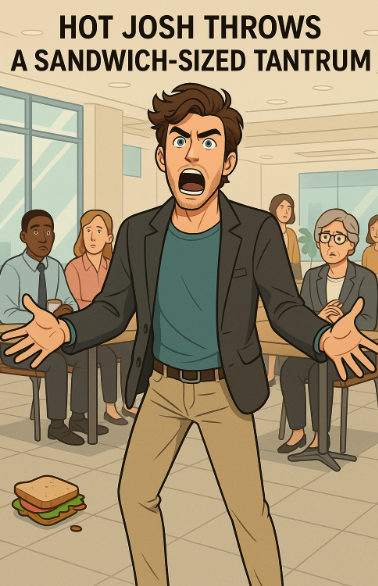
🥪 THE STORY: They were handing out catered sandwiches in the breakroom—one of those mandatory corporate “let’s pretend we’re a family” events. Everyone was faking laughter, hovering around the deli tray like seagulls with student loans. I grabbed a turkey and swiss and made the mistake of sitting across from Brad from accounts payable.
Brad, with his khaki confidence and Bluetooth earpiece still in, made the fatal error of saying, “Wow, Josh, you always go for the turkey. So predictable.”
Now. Normally, a less evolved version of me would’ve laughed this off. But that day? That day, I ascended.
I stood up, sandwich in hand, and announced to the entire room that I felt deeply unsafe in that environment. I declared the joke micro-aggressive, speciesist (don’t ask), and structurally violent. I demanded the event be shut down for an investigation and, when someone tried to offer me hummus and pita as an apology, I threw it directly into the recycling bin to symbolize wasteful corporate gaslighting.
The next morning, HR scheduled mandatory sensitivity training. Brad now brings his own lunch and stares at the floor. And me? I don’t even eat turkey anymore. I have it delivered, hand-fed by a freelancer who signs a non-disparagement clause.
🎓 LESSON LEARNED: If your feelings are hurt, that’s not a moment for reflection—it’s a moment for institutional upheaval. One small slight is all it takes to become the hero of a story no one else asked for.
Fresh out of college, I walked into my very first real job interview like I was the solution to every problem this company didn’t know it had. I had on a blazer I bought at a thrift store, khakis that thought they were dress pants, and a level of confidence so disproportionate to my experience that it could’ve been measured on the Richter scale.
I sat down, introduced myself, and when they asked what salary I was expecting, I didn’t flinch.
“One-hundred and twenty-five thousand,” I said. “Base. Not including bonuses, of course.”
The interviewer blinked at me like I had just told him I was a time traveler.
“Do you have experience in this industry?” he asked.
“No,” I replied. “But I’m here. And presence is powerful.”
There was a pause so long it got awkward. I tried to fill it.
“I’ve been on time to things. I understand email. I know how to delegate, even though I’ve never had anyone to delegate to. And I read somewhere that people with confidence are statistically more successful.”
Then I leaned in and whispered, “I’m basically a walking ROI.”
Needless to say, I did not get the job. But I did get a LinkedIn connection request from the HR intern, probably just to keep tabs on me in case I somehow became a threat to corporate America.
Lesson Learned: Confidence is key, but delusion is not a career path. Turns out, showing up is only half the battle. The other half? Actually knowing something and… you know, working. Who knew?
I was just trying to order a Spicy Deluxe Combo from a drive-thru—classic craving, nothing outrageous. It was a Wednesday, I was 27, and I remember because I was wearing my gray hoodie with the bleach stain I had convinced myself was “a vibe.”
I roll up to the speaker.
“Hi, welcome to Chick-” And before the sentence could even finish, the voice goes: “Ma’am, can you speak up?”
Ma’am. MA’AM.
Excuse me? Hot Josh is many things: punctual, glowing, emotionally unbothered—but ma’am is not one of them.
I froze. I felt my dignity trying to crawl out of the car.
“No offense,” I said, “but if we’re throwing around honorifics, let’s at least get the pronouns right.”
A pause. Then a stammered, “Oh, uh—sorry, sir?”
It was too late. The entitlement switch flipped on. I wasn’t even mad. I was activated.
I pulled around, took off my hoodie like I was about to do a catwalk, fixed my hair in the rearview mirror, and glided to the window like I was about to audition for America’s Next Top Customer.
The kid at the window looked 15 and terrified. I smiled.
“Do I look like a ma’am?” He blinked. “No?” “Exactly. That’s the energy. Let’s match it next time.”
I took my sandwich and large waffle fries with the grace of a red carpet queen and drove off like nothing had happened. Did I circle back just to repeat the order into the speaker in a deeper voice? Maybe.
Consequences?
I now get called “boss,” “king,” or sometimes just “uhhh” at drive-thrus.
Lesson Learned?
Entitlement isn’t always about getting what you want—it’s about reminding the world that you are Hot Josh, and respect is the minimum.
I was 24 years old and out with friends at a well-known Italian chain restaurant, the kind that promises endless soup, salad, and—most importantly—unlimited breadsticks. It was a casual Tuesday night, and I had already cleared through three baskets before the waiter’s enthusiasm noticeably waned.
“More breadsticks, please,” I requested with the confidence of a man who knew his rights.
“Of course,” the waiter said, forcing a smile. Ten minutes later, a single lonely breadstick arrived.
“Just one?” I asked.
“Uh… yeah, we’re just spacing them out,” the waiter replied. Suspicious.
I decided to test this newfound rationing policy. I made direct eye contact and said, “I’ll take another round of unlimited breadsticks.“
A manager appeared soon after. “Sir, we just want to make sure you’re enjoying your meal and not… stockpiling.”
Stockpiling? What was this, a black-market breadstick operation?
I doubled down. “Are they unlimited or not?”
The manager hesitated. “Well, yes… but… in reason.”
“Define ‘reason,’” I said, because words matter.
After an awkward silence, six more baskets arrived. Victory.
But the triumph was short-lived. Thirty minutes later, the bill arrived—with an added charge labeled ‘Excessive Breadstick Consumption Fee – $7.99.’
I fought it. I had no regrets. But legal action seemed excessive over doughy carbs, so the battle ended in a compromise: they waived the fee, and I agreed not to request any more breadsticks.
Lesson learned? If a restaurant promises unlimited, they better mean it.
At age 28, I found myself locked in a passive-aggressive war over the office thermostat. It all started on a Monday morning when I walked into what could only be described as a corporate igloo. Someone—some monster—had set the thermostat to 64 degrees. Sixty-four! Inside!
I, a person of reason and warmth, immediately adjusted it to a civilized 72. By lunch, it was back at 64. This was not a coincidence. This was war.
The next day, I arrived early and cranked it to 75—a tactical preemptive strike. By mid-morning, it was back to 64. I left passive-aggressive notes. They left cryptic responses like “Some of us don’t want to sweat through our shirts.” To which I replied, “Some of us don’t want to contract hypothermia at our desks.”
Things escalated. I bought a space heater. They hid the space heater. I locked the thermostat cover. They stole the key. It was an arms race of petty proportions.
Eventually, HR intervened. A compromise was reached—69 degrees. Nobody was happy, which apparently meant it was “fair.”
Lesson learned? Some battles aren’t about winning. They’re about making sure everyone else suffers equally.
I was on top of the world—or at least that’s how it felt cruising in my newly leased sports car, a machine so sleek it practically whispered, “You’re better than everyone else.” It was the kind of car that begged to be shown off, and there was no better place than the city’s most exclusive shopping district.
The street gleamed with luxury storefronts, each window a shrine to the absurdly overpriced. Naturally, I believed my car deserved the best, which obviously meant parking right in front of the swankiest store, in a spot clearly marked “Reserved for VIPs Only.”
“Reserved for me,” I muttered confidently, tossing my keys with a flair that I was certain made me look like a Hollywood A-lister. After all, who was more VIP than a guy driving this beauty?
I strutted through the store, oozing entitlement with every step, basking in the envious glances of other shoppers. There was nothing like the ego boost of watching people try to figure out if they’d seen my face on TV.
Thirty minutes and a few unnecessary purchases later, I exited the store, expecting to find my car gleaming in the sun, perfectly untouched and admired from a distance. Instead, I found a parking officer leaning against the hood, writing a ticket with the enthusiasm of someone who’d been waiting for this moment their entire career.
I marched over, fully prepared to assert my VIP status. “Hey, this is obviously a mistake. That spot is for VIPs.” I pointed at the sign, then at myself, as if that would magically make the ticket vanish.
The officer looked me up and down, unimpressed. “Do you have a VIP permit?”
I faltered. “A what?”
“A VIP permit. You know, the kind issued by the city for this exact spot?”
I stammered, “Well, no, but I’m clearly… I mean, just look at the car!”
The officer’s deadpan expression could have withered a houseplant. “Nice car. But no permit, no parking.”
I tried charm, persuasion, even a hint of flirtation. But the officer wasn’t buying it. He handed over the ticket, adding with a smirk, “That’ll be $250. Enjoy your day, ‘VIP.’”
The realization hit me like a ton of bricks. The entitlement that had been propping me up came crashing down, leaving me with nothing but an expensive lesson in humility—and a parking ticket to match.
As I drove away, my ego a little bruised, I vowed to never assume I was above the rules again… at least until the next time I found a spot too good to pass up.
Lesson Learned: Just because I felt like a VIP didn’t mean the law agreed.
I was 23, out for a group dinner at one of those trendy, overpriced restaurants—the kind that puts microgreens on everything and charges $5 for “handcrafted” ice cubes. The food was fine, nothing spectacular, but I was there more for the company than the meal.
Then the bill arrived. And there it was, hiding among the usual overpriced nonsense: a $3 charge for splitting an entrée.
I hadn’t split an entrée.
I flagged down the waiter. “What’s this?” I asked, pointing at the charge.
“Oh, that’s a standard fee if we see food being shared.”
Now, let’s be clear—at no point did I hand my plate over to anyone. All that happened was that I let my friend take a single bite from my dish. One bite. And they wanted three bucks for it.
This was war.
The Handling of It
I sat back, crossed my arms, and prepared for battle. “So, if I had eaten the whole thing myself, there wouldn’t be a charge. But because a single forkful traveled across the table, that’s three dollars?”
The waiter, clearly trained for this nonsense, shrugged. “It’s just the policy.”
“Well, my policy is not paying for things I didn’t do.”
The table went quiet. My friends, clearly entertained, watched as I prepared my case like a lawyer in a courtroom drama. I pointed out that no extra plate was brought, no food was divided, and that my single act of generosity shouldn’t come with a financial penalty.
The waiter, growing uncomfortable, called over the manager. The manager, in turn, gave me a tired look like she had fought this battle too many times before. “Sir, it’s really just a small charge.”
“If it’s so small, take it off,” I said.
Now it was a principle thing. They were betting I’d let it go because it was ‘just’ three dollars. But I knew if I caved, I’d be sending a message: that I was okay with being nickel-and-dimed for nothing.
The Consequences
The manager sighed, pulled out a pen, and scribbled the charge off the bill. Victory. I smiled, thanked her, and handed over my card—because I’m not a monster, I still paid for my meal. Just not for their ridiculous charge.
As we left, my friend patted me on the back. “That was inspiring,” he said.
“I know,” I replied.
And that’s how I won three dollars and the moral high ground in one night.
Lesson Learned
Always check the bill. Always challenge nonsense fees. And most importantly, never let a restaurant charge you for being nice.
Responses are generated with the assistance of AI and are not guaranteed to be 100% accurate. If you are unsure, please drop us a line at [email protected].