Diversified Company BBB Business Review
Hot Josh and the Quadrillionaire Queen of Entitlement

BASED ON A TRUE STORY FROM AN EXPERIENCE ON 11/5/2026

I’ve always believed there’s someone out there for everyone.

A soulmate.

A perfect match.

Someone who understands your deepest feelings, shares your values, and sees the world the same way you do.

For some people, it’s about kindness.

For others, intelligence.

A sense of humor.

Shared interests.

Physical attraction.

For me?

Entitlement.

I want someone who looks at a perfectly reasonable company policy and immediately wonders why it should apply to her.

Someone who believes the word “no” is simply an invitation to continue negotiating.

Someone who understands that wanting something and deserving something are essentially the same thing.

Someone who doesn’t allow minor inconveniences like product descriptions, available features, or the laws of mathematics to interfere with her expectations.

I thought such a woman might exist.

I just never imagined she’d find me through Etsy.

And certainly not by purchasing a $14.99 novelty credit card.

But love works in mysterious ways.

Especially when the prospective love of your life claims to be a quadrillionaire.

Let me explain.

As you may know, I am the President of the Bank of Entitlement.

An institution dedicated to recognizing the extraordinary needs of people who believe the world owes them something.

We specialize in novelty banking merchandise.

Fake credit cards.

Novelty checks.

Imaginary wealth.

Real laughter.

Our products are designed for people who appreciate the absurdity of entitlement.

We are not an actual bank.

We do not issue functioning credit cards.

We do not provide real checking accounts.

We do not extend credit.

We do not manage deposits.

And, despite repeated requests, we do not offer unlimited imaginary wealth convertible into actual United States currency.

A disappointing limitation.

I know.

But even my institution has boundaries.

Occasionally.

Then she arrived.

For privacy purposes, I’ll call her Dr. Jane Doe.

A distinguished title.

A mysterious woman.

And, as I would soon discover, a financial visionary operating on a level that conventional banking simply cannot comprehend.

She purchased one of our novelty credit cards.

Price: $14.99.

A reasonable investment in imaginary financial prestige.

The product offered two personalization options.

A cardholder name, limited to twenty-one characters.

And an entitlement date.

That’s it.

Simple.

Elegant.

Understandable.

Or so we thought.

Dr. Doe submitted three initials for her cardholder name.

She supplied an entitlement date.

Our production team reviewed the information.

Then contacted her to clarify the personalization.

A courtesy.

A professional gesture.

An attempt to ensure accuracy.

We even delayed processing while awaiting her response.

She didn’t respond.

At first, I was concerned.

Had something happened?

Was she traveling?

Was she busy?

Had her quadrillion-dollar empire experienced a liquidity event?

Perhaps she was occupied negotiating the acquisition of Switzerland.

I couldn’t know.

Eventually, the order was fulfilled using the information she had actually submitted.

Three initials.

The requested entitlement date.

Exactly as advertised.

We even included complimentary novelty checks as a courtesy.

Generous.

Thoughtful.

Completely unnecessary.

And that’s when the romance began.

She contacted us.

The card wasn’t what she wanted.

Apparently, she expected considerably more.

An actual EMV chip.

Visa or Mastercard branding.

A security code.

Additional personal information.

Professional credentials.

Business identifiers.

And an expiration date.

Not an entitlement date.

An expiration date.

On a novelty card that doesn’t expire because it doesn’t actually do anything.

I stared at the message.

Then read it again.

Then slowly leaned back in my chair.

My heart began racing.

Who was this woman?

Where had she been all my life?

She had purchased a gag gift and expected an entirely different product.

Not just different printing.

Different functionality.

Different branding.

Different specifications.

Potentially an entirely different financial institution.

All for $14.99.

Magnificent.

I whispered to myself:

“She’s perfect.”

Then I read the next part.

She wanted a replacement.

Free.

And she was perfectly willing to keep the original card, which she indicated she liked.

I stood up.

Walked to the window.

Looked toward the heavens.

And whispered:

“Dear God. Is this the one?”

Because this wasn’t ordinary entitlement.

This was advanced entitlement.

Professional-grade entitlement.

The kind of entitlement that requires absolutely no supporting evidence beyond personal preference.

She wanted to keep the product she liked.

Receive another product she hadn’t ordered.

Pay nothing additional.

And have us absorb the cost of manufacturing something we don’t even sell.

I was in love.

Not actual love, of course.

I hadn’t met her.

I didn’t know anything meaningful about her personally.

But philosophically?

We were already discussing marriage.

I imagined our first date.

We’d arrive at a restaurant without reservations.

Demand the best table.

Order everything on the menu.

Then explain that because we’d only eaten some of it, we should receive a partial refund.

She’d ask for a complimentary dessert.

I’d demand the manager waive the service charge.

We’d look into each other’s eyes.

And simultaneously say:

“That’s not what I expected.”

Beautiful.

Absolutely beautiful.

Then came another revelation.

She informed us that she was a quadrillionaire.

A quadrillionaire.

I had to sit down.

For those unfamiliar with the number, a quadrillion is one thousand trillion.

An amount so large that most people only encounter it while discussing national debt projections or particularly ambitious science-fiction villains.

And here was a woman claiming that level of wealth while disputing a $14.99 novelty credit card.

Incredible.

Financial discipline.

Extraordinary attention to detail.

The willingness to protect every dollar, even when allegedly possessing one quadrillion of them.

I grabbed my calculator.

Fourteen dollars and ninety-nine cents divided by one quadrillion.

The result was so small that my calculator practically refused to acknowledge its existence.

And yet she was fighting for it.

That’s commitment.

That’s principle.

That’s a woman who knows her worth.

Or at least has assigned herself a very impressive numerical value.

Then she explained that she managed her own bank.

My heart skipped another beat.

A banker.

I was a banker.

Well.

A novelty banker.

But still.

Two financial executives.

Two institutions.

Two people who understood the power of declaring themselves entitled.

I began imagining a merger.

BANK OF ENTITLEMENT INTERNATIONAL QUADRILLIONAIRE HOLDINGS.

Assets under management:

Imaginary.

Customer expectations:

Unlimited.

Regulatory compliance:

Let’s not get distracted.

Then came her proposed expiration date.

05/15/9099.

The year 9099.

I stared.

Then stared harder.

Most credit cards expire after a few years.

Hers would apparently remain valid for more than seven thousand.

I admired the ambition.

A woman planning for the long term.

Very long term.

The kind of long term that requires assuming civilization, banking networks, and plastic cards will all survive until the ninety-first century.

I imagined our anniversary.

Year 9099.

Still together.

Still arguing about the original $14.99.

Romantic.

Then the correspondence continued.

Our customer service team explained that the card was a novelty product.

That it had fixed specifications.

That it didn’t offer the requested features.

That the original card had been manufactured exactly as ordered.

That we had attempted to clarify her instructions before production.

And that a complimentary replacement was not warranted.

A perfectly reasonable response.

Which, naturally, she rejected.

I admired her persistence.

A lesser customer might have accepted the explanation.

A less committed individual might have read the product listing.

A person lacking vision might have acknowledged that a novelty credit card cannot magically become a legitimate financial instrument.

Not Dr. Doe.

No.

She pressed forward.

She wanted her full professional name.

Business initials.

Additional identifiers.

Modified wording.

And an expiration date.

Never mind the twenty-one-character limit.

Twenty-one characters are merely a suggestion to someone whose financial aspirations extend to fifteen digits.

Actually, sixteen.

But who’s counting?

Apparently, we were.

Because the card still had a twenty-one-character limit.

We explained this again.

And again.

And again.

Then she delivered a statement so profound that I immediately considered having it engraved above the entrance to our corporate headquarters.

“the BANK IS ENTITLED and WEALTH with no limitations.”

I read those words.

Slowly.

Carefully.

With reverence.

The bank is entitled.

And wealth.

With no limitations.

I didn’t completely understand the grammar.

But I understood the spirit.

This woman wasn’t merely a customer.

She was a movement.

A revolution.

A walking declaration that limitations exist only for people willing to acknowledge them.

I wiped away an imaginary tear.

Then asked my staff to review the message.

Three of us examined the correspondence.

Three adults.

Multiple years of combined customer service experience.

And not one of us could confidently explain everything she was trying to communicate.

This was extraordinary.

Most customers are entitled within the boundaries of understandable language.

She had transcended those boundaries.

She was operating in an entirely new dimension.

A dimension where sentences are optional, punctuation is negotiable, and the meaning of words depends entirely on the level of personal conviction behind them.

Then came another message.

And this one deserves special recognition.

She wrote:

“I understand your business policy INACCURATELY communications forecasts as combinations by nominations and sternations the populations and accurately affordable the business CRITERIA not justifications compelling uniformity versus conformity. Thanks and where are the checks . I never received any notices and ESCALATION the ETSY from this era and error”

I stared at my screen.

Then read it again.

Then once more.

I understood approximately seven words.

But what words they were.

Communications.

Forecasts.

Nominations.

Populations.

Criteria.

Uniformity.

Conformity.

This wasn’t a customer complaint.

This was a United Nations resolution being transmitted from another galaxy.

I called an emergency meeting.

Three of us reviewed the message.

We examined the sentence structure.

Considered the possible meanings.

Discussed the context.

Attempted to identify the actual request.

After considerable analysis, we reached one unanimous conclusion.

She wanted to know where her novelty checks were.

Success.

A breakthrough.

We had decoded the message.

Unfortunately, the tracking information had already been provided through Etsy.

The same Etsy account she was using to send us messages.

The same portal that displayed her order history.

The same platform where shipping updates were available.

Apparently, she had discovered Etsy’s messaging function but had not yet fully explored its other revolutionary capabilities.

Like checking an order.

Or viewing tracking information.

Or reading a product description.

I admired her selectivity.

Why waste time reviewing information already available when you can demand that someone else retrieve it for you?

That’s not laziness.

That’s delegation.

Executive-level delegation.

I was increasingly convinced we were destined for one another.

Then she informed us that our Facebook page was unavailable.

We provided the correct link.

Explained how to find it.

And invited her to join the conversation.

After all, we were documenting the experience, with her identifying information concealed.

And I wanted her to see the public discussion.

Not because I wished to embarrass her.

But because I genuinely believed she deserved recognition.

The world needed to know that someone had finally achieved a level of entitlement that made even the Bank of Entitlement question its own standards.

Then the tone changed.

She accused the company of being rude.

Shrewd.

Ignorant.

She objected to commentary about her business affairs.

She insisted that her accomplishments and professional status were not ours to question.

And on that particular point, I agreed.

Her professional accomplishments weren’t relevant to the transaction.

Neither was her claimed wealth.

Neither was her bank.

Neither was the future of the global financial system.

The only relevant question was whether the $14.99 novelty card had been produced according to the information submitted.

It had.

We had the original order.

We had the personalization details.

We had the correspondence.

We had the product specifications.

We had even provided photographic evidence showing exactly what had been requested.

But she remained undeterred.

She declared that a replacement was her choice.

Her choice.

I read that sentence aloud.

Then stood up and applauded.

Alone.

In my office.

Because finally, someone had expressed the central philosophy of entitlement with breathtaking clarity.

If I choose a particular outcome, the other party should be obligated to provide it.

Beautiful.

Wrong.

But beautiful.

She had selected “replacement” as her preferred resolution.

Therefore, in her mind, replacement was no longer a request.

It was an instruction.

A command.

A royal decree.

The seller’s agreement was apparently unnecessary.

I imagined her ordering a small pizza.

Receiving a small pizza.

Then declaring that she’d prefer a large pizza.

Free.

While keeping the small one.

And when the restaurant refused, she’d simply explain that she’d selected “large” as her preferred resolution.

Case closed.

I was impressed.

I was inspired.

I was slightly frightened.

And then something happened that changed everything.

I realized she wasn’t merely entitled.

She was more entitled than me.

Me.

Hot Josh.

The man who once attempted to negotiate hotel checkout times.

The man who questioned movie theater armrest ownership.

The man who treated a coffee shop as commercial office space.

The man who investigated unlimited breadsticks until his digestive system threatened litigation.

The man who tracked a delivery truck around town for nine hours because he wanted a phone charging cable.

I had spent years perfecting the art of entitlement.

And this woman had arrived with a $14.99 purchase and completely destroyed my record.

She hadn’t merely raised the bar.

She’d demanded a replacement bar.

With additional features.

Free.

And insisted that the original bar be returned to her as a complimentary gift.

I knew what had to be done.

I called an emergency meeting of the Bank of Entitlement Board of Directors.

Attendance:

Me.

President.

Chairman.

Chief Executive Officer.

Acting Director of Customer Expectations.

And, for purposes of maintaining a quorum, my reflection in the conference room window.

The meeting was called to order.

I presented the evidence.

The original order.

Three initials.

One entitlement date.

The unanswered clarification request.

The correctly manufactured novelty card.

The complimentary checks.

The demands for features we didn’t offer.

The quadrillionaire declaration.

The year 9099.

The repeated refund and replacement demands.

The increasingly elaborate correspondence.

And, of course, the unforgettable statement:

“the BANK IS ENTITLED and WEALTH with no limitations.”

I looked around the conference room.

Silence.

My reflection appeared deeply moved.

I proposed a motion.

That Dr. Jane Doe be recognized as the single most extraordinary example of consumer entitlement encountered by the Bank of Entitlement during the 2026 calendar year.

The motion was seconded.

By me.

The vote was unanimous.

Two to zero.

My reflection abstained due to a potential conflict of interest.

The decision was final.

We had a winner.

I immediately ordered the creation of an award.

Not an ordinary certificate.

Not a generic participation trophy.

Something worthy of this historic achievement.

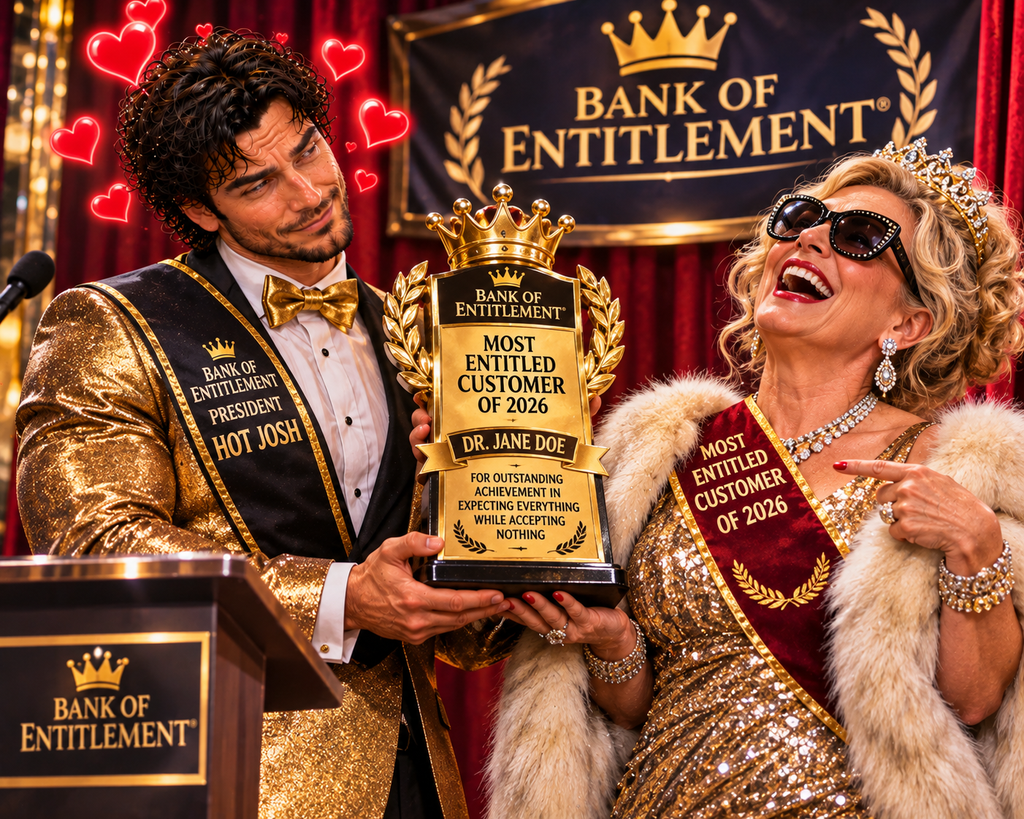
A magnificent gold-plated trophy.

A crown.

A miniature novelty credit card.

A tiny stack of imaginary checks.

And a pedestal bearing the inscription:

BANK OF ENTITLEMENT

MOST ENTITLED CUSTOMER OF 2026

DR. JANE DOE

FOR OUTSTANDING ACHIEVEMENT IN EXPECTING EVERYTHING WHILE ACCEPTING NOTHING

I also considered including the phrase:

QUADRILLIONAIRE DIVISION

But the engraver informed me that the available space was limited.

Naturally, I demanded that he add it anyway.

He refused.

I understood.

Painfully.

For the first time, I knew exactly how our customer felt.

Then came the award ceremony.

I rented a ballroom.

Well.

I imagined renting a ballroom.

This is a novelty bank.

Our entertainment budget is largely theoretical.

But in my mind, the ceremony was magnificent.

Golden chandeliers.

Red carpet.

A twenty-piece orchestra.

Champagne fountains.

An audience filled with customer service representatives, Etsy sellers, small-business owners, and people who had spent their entire careers explaining that advertised product specifications actually mean something.

The lights dimmed.

A spotlight illuminated the stage.

I approached the podium.

“Ladies and gentlemen, distinguished guests, fellow sufferers of unreasonable expectations…”

The audience erupted in applause.

I raised my hand.

“Tonight, we recognize an individual who has demonstrated extraordinary dedication to the principles upon which this institution was founded.”

More applause.

“An individual who refused to allow the limitations of a $14.99 novelty product to interfere with her vision.”

Standing ovation.

“A woman who believed a novelty credit card should possess features not advertised, not manufactured, and not available.”

Thunderous applause.

“A woman who, despite claiming a personal fortune of one quadrillion dollars, remained unwavering in her pursuit of a complimentary replacement.”

The crowd went wild.

“And most importantly, a woman who taught us that selecting a preferred resolution is apparently the same as receiving authorization to demand it.”

I paused.

Looked toward the audience.

And smiled.

“Tonight, I am honored to present the Bank of Entitlement’s highest distinction…”

The orchestra began playing.

A golden curtain rose.

Confetti fell from the ceiling.

“…the MOST ENTITLED CUSTOMER OF 2026 AWARD!“

The room exploded.

Cheers.

Applause.

Standing ovations.

Someone in the back began crying.

Possibly a customer service manager.

I continued.

“Please join me in congratulating our distinguished recipient, Dr. Jane Doe!”

In my imagination, she approached the stage.

Elegant.

Confident.

Absolutely convinced that the award should have been presented sooner.

I handed her the trophy.

She examined it.

Turned it around.

Studied the inscription.

Then looked at me.

“Is this real gold?”

I smiled.

“No. It’s novelty gold.”

She frowned.

“I requested real gold.”

My heart fluttered.

There she was.

My soulmate.

I smiled.

“Of course you did.”

She examined the trophy again.

“Can you replace it?”

The audience fell silent.

I looked into her eyes.

She looked into mine.

Two souls.

One philosophy.

Unlimited expectations.

Zero concessions.

I leaned toward the microphone.

“Madam, you have just demonstrated exactly why you deserve this award.”

The crowd erupted again.

I continued.

“And because I am the President of the Bank of Entitlement, I am personally entitled to make the final determination regarding all awards, refunds, replacements, redesigns, modifications, and imaginary financial instruments issued by this institution.”

She waited.

I smiled.

Then delivered the final ruling.

“Your award is APPROVED.”

Applause.

“Your title as Most Entitled Customer of 2026 is CONFIRMED.”

More applause.

“Your extraordinary contributions to the advancement of entitlement are hereby recognized for all eternity, including through May 15, 9099.”

The orchestra swelled.

I raised one finger.

“However, your refund request remains DENIED.”

Silence.

“Your replacement request remains DENIED.”

I paused.

“Your request for additional card features remains DENIED.”

The audience leaned forward.

“Your request to redesign the product remains DENIED.”

Then I smiled.

“And because I am entitled to have the last word…”

I leaned closer to the microphone.

“DENIED.”

The orchestra exploded into its final triumphant chord.

Confetti rained down.

The audience stood.

I raised the trophy above my head.

And for one glorious moment, I realized something.

I had finally met someone whose sense of entitlement rivaled my own.

Someone who understood the beauty of unreasonable expectations.

Someone who refused to accept that reality might occasionally impose limitations.

Someone who believed the universe should accommodate her preferences.

Perhaps she really was my soulmate.

But there was one problem.

Two people who are always entitled to get their way cannot possibly have a successful relationship.

Because eventually, one of them has to compromise.

And neither of us was qualified.

So I made the only reasonable decision.

I would admire her from a distance.

Respect her accomplishments in the field of entitlement.

Honor her with the highest award my fictional financial institution could bestow.

And maintain a strict separation between romance and customer service.

Because love may be unconditional.

But refunds are not.

The lesson?

Hot Josh has spent years believing he’s entitled to the best of everything.

The best service.

The best treatment.

The best opportunities.

The last word.

But sometimes, someone comes along who reminds you that there are levels to this profession.

And this woman?

She’s in a league of her own.

She purchased a novelty credit card.

Expected a real financial instrument.

Requested features that didn’t exist.

Wanted a free replacement.

Intended to keep the original.

Claimed to be a quadrillionaire.

Proposed an expiration date in the year 9099.

And refused to accept the word “no.”

For that, she has earned the admiration of Hot Josh and the highest honor the Bank of Entitlement can provide.

Congratulations, Dr. Jane Doe.

You are officially the Bank of Entitlement’s MOST ENTITLED CUSTOMER OF 2026.

Your trophy is imaginary.

Your title is honorary.

Your quadrillions remain unverified.

Your novelty card remains exactly what you ordered.

And your refund?

DENIED.

Your replacement?

DENIED.

Your appeal to my romantic sensibilities?

Under consideration.

But the last word?

That’s mine.

Because I’m Hot Josh.

President of the Bank of Entitlement.

And if anyone is entitled to the last word around here…

IT’S ME.

CASE CLOSED.

DENIED.
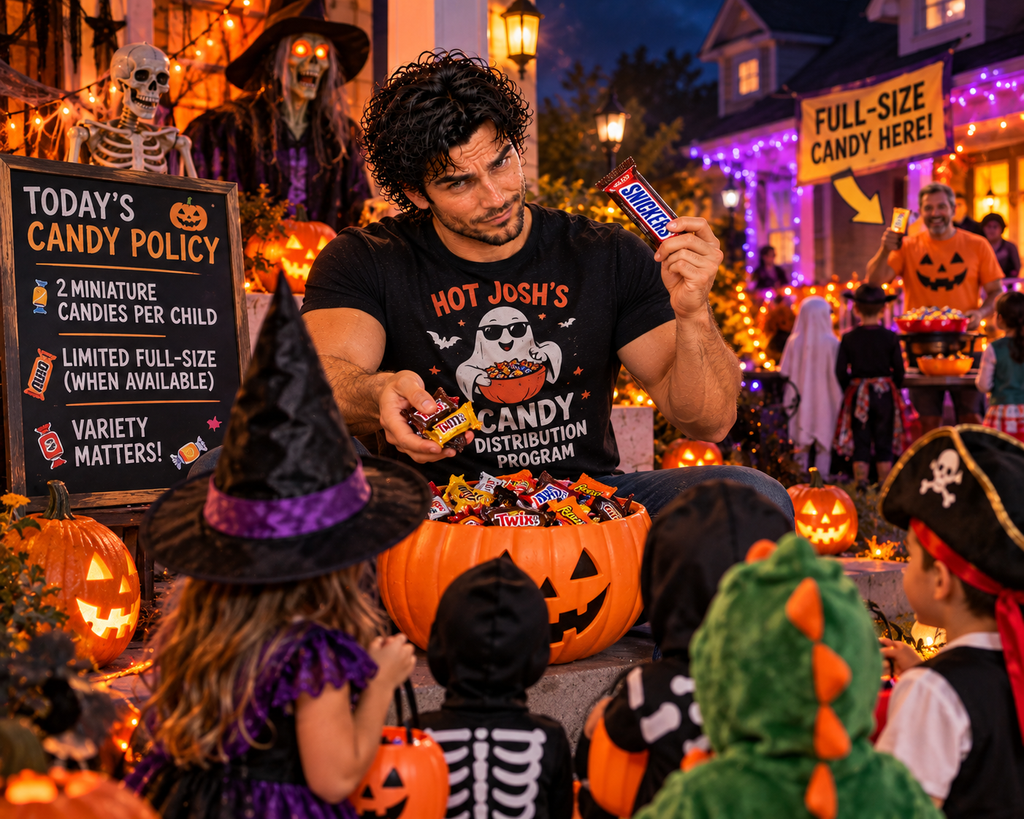
Hot Josh and the Halloween Candy Redistribution Program

Halloween.

My favorite holiday.

Not because of the costumes.

Not because of the decorations.

Not even because of the opportunity to watch grown adults spend hundreds of dollars making their houses look abandoned.

No.

Halloween is special because it’s the one night of the year when society collectively agrees that strangers should distribute free merchandise to people who knock on their doors.

An extraordinary business model.

No purchase necessary.

No loyalty program.

No subscription.

Just show up.

Request candy.

Receive candy.

Beautiful.

Naturally, I had concerns about how the program was being administered.

It started at 5:47 p.m.

I was standing on my front porch admiring my Halloween decorations.

Fog machine.

Orange lights.

Three skeletons.

A giant inflatable pumpkin.

And a motion-activated witch that screamed every time somebody walked past.

Excellent.

I’d spent $286 transforming my front yard into a temporary supernatural attraction.

Worth every penny.

Then I noticed something across the street.

My neighbor was handing out full-size candy bars.

Full.

Size.

Not the tiny ones.

Not the individually wrapped pieces that require six servings to equal one respectable chocolate bar.

Actual full-size candy.

I watched a child approach.

“Trick or treat!”

My neighbor smiled.

Handed over a full-size chocolate bar.

The child gasped.

Understandable.

Then another child approached.

Another full-size bar.

Then another.

And another.

I stood there.

Processing.

My own candy bowl contained miniature chocolates.

Perfectly good miniature chocolates.

But miniature nonetheless.

Suddenly, my entire Halloween operation looked underfunded.

I walked across the street.

“Good evening.”

My neighbor smiled.

“Hey, Josh! Happy Halloween!”

“Happy Halloween.”

I looked at the candy bowl.

Then at him.

Then back at the candy bowl.

“Full-size bars?”

“Yep!”

“Interesting.”

He smiled.

“Kids love them.”

“Of course they do.”

I folded my arms.

“Have you considered the economic consequences?”

He blinked.

“What?”

“The economic consequences.”

“Of candy?”

“Of distributing premium merchandise without coordinating with neighboring providers.”

He laughed.

“Josh, it’s Halloween.”

“Exactly. A highly competitive seasonal marketplace.”

He stared at me.

I continued.

“You’re establishing unrealistic consumer expectations.”

He laughed harder.

“How?”

“Children leave your house with a full-size candy bar.”

“Right.”

“Then they come to my house.”

“Okay.”

“And receive a miniature.”

He nodded.

“So?”

“So now my customer satisfaction ratings are in jeopardy.”

He nearly dropped the bowl laughing.

“You’re ridiculous.”

“That’s not a denial.”

I returned home.

Looked at my candy.

Then at his candy.

Then at mine again.

This was unacceptable.

I needed a strategy.

At 6:12, I implemented a new distribution policy.

TWO MINIATURE CANDIES PER CHILD.

Generous.

Competitive.

Financially responsible.

The first group approached.

Four children.

A pirate.

A princess.

A dinosaur.

And something that appeared to be a haunted refrigerator.

I admired the creativity.

“Trick or treat!”

I smiled.

“Happy Halloween!”

I handed each child two candies.

The pirate looked inside his bag.

Then looked at me.

“Only two?”

I froze.

Only?

ONLY?

I leaned forward.

“Excuse me?”

He pointed across the street.

“That house gives big candy bars.”

There it was.

Market disruption.

I knew this would happen.

I smiled.

“Yes, but we offer a diversified candy portfolio.”

The pirate stared.

“What?”

“Two different varieties.”

He looked at his candy.

Then at me.

Then at his mother.

His mother was laughing.

I continued.

“Some houses specialize in quantity. Others focus on variety.”

The dinosaur interrupted.

“Can I have another?”

I looked at him.

“Have you completed the customer satisfaction survey?”

His mother laughed even harder.

The dinosaur looked confused.

I handed him another candy.

“Consider that a promotional bonus.”

The group left.

I returned to my porch chair.

And began evaluating my position.

By 6:45, I’d distributed forty-seven pieces of candy.

Across the street, my neighbor continued handing out full-size bars.

Children were literally running toward his house.

Running.

Meanwhile, several approached mine at a leisurely pace.

One actually skipped my driveway.

Skipped it.

I watched in disbelief.

Apparently brand loyalty was dead.

At 7:03, I decided to conduct a competitive analysis.

I crossed the street again.

My neighbor saw me coming.

“Oh, here we go.”

I smiled.

“Quick question.”

He laughed.

“Of course.”

“How many candy bars have you distributed?”

“I don’t know. Maybe seventy?”

Seventy.

Full-size.

I mentally calculated the expense.

“What’s your cost per customer?”

He stared.

“My what?”

“Cost per customer.”

“Josh, I bought candy at the store.”

“Without a budget?”

He laughed.

“Without a spreadsheet, yes.”

Reckless.

Absolutely reckless.

I looked at his candy bowl.

Then at him.

“Are you accepting adults?”

He raised an eyebrow.

“Adults?”

“For candy.”

He laughed.

“Sure. Why not?”

Excellent.

I extended my hand.

“Trick or treat.”

He stared at me.

Then burst out laughing.

“You’re serious?”

“Completely.”

He handed me a full-size chocolate bar.

Victory.

I examined it.

Perfect.

Unopened.

Premium quality.

Then I returned to my house.

And immediately placed the candy bar in my own bowl.

I had acquired competitive inventory.

At 7:19, a little girl dressed as a witch approached.

“Trick or treat!”

I smiled.

“Happy Halloween!”

She looked at the bowl.

Saw the full-size candy bar.

And gasped.

“Can I have that one?”

I looked at the bar.

Then at her.

Then at the bar.

This was a difficult moment.

My only full-size item.

My flagship product.

My competitive advantage.

I considered explaining that it was display merchandise.

Then I looked at her costume.

Pointed hat.

Purple cape.

A broom almost as tall as she was.

She had clearly put effort into the occasion.

I handed her the candy bar.

Her face lit up.

“REALLY?”

I nodded.

“Really.”

“THANK YOU!”

She ran toward her parents.

Holding the candy bar over her head like she’d won an Olympic medal.

Her mother smiled and waved.

I waved back.

And something strange happened.

I felt good.

Not the usual good that comes from getting something for free.

Not the satisfaction of winning an argument.

Not even the thrill of securing a complimentary upgrade.

Something different.

I had given away the best thing I had.

And somehow, that felt better than keeping it.

Disturbing.

Very disturbing.

At 7:42, I noticed an older gentleman walking slowly down the sidewalk.

He wasn’t wearing a costume.

He wasn’t carrying a candy bag.

He was simply enjoying the decorations.

He stopped to admire my giant pumpkin.

“Looks great!”

“Thank you.”

He smiled.

“Quite a display.”

I nodded proudly.

“Two hundred eighty-six dollars.”

He laughed.

“Well, it looks like you got your money’s worth.”

I looked at my candy bowl.

Then at him.

“Would you like some candy?”

He smiled.

“Oh, no. That’s for the kids.”

I shrugged.

“You’re somebody’s kid.”

He laughed.

“Well, I suppose that’s true.”

I handed him a chocolate.

He thanked me.

And continued walking.

Another successful transaction.

No revenue.

No profit.

No complaint.

This Halloween business model was beginning to make sense.

At 8:15, trick-or-treating was winding down.

The streets grew quieter.

The fog machine sputtered.

The inflatable pumpkin leaned slightly to the left.

And my motion-activated witch had screamed so many times that I was beginning to question her commitment to customer service.

I looked into my candy bowl.

Six pieces remained.

Six.

I considered keeping them.

After all, I’d paid for them.

Then I noticed a little boy approaching with his father.

The boy wore a homemade robot costume.

Cardboard boxes.

Silver paint.

A collection of buttons drawn on with markers.

His father carried a flashlight.

The boy walked up.

“Trick or treat!”

I smiled.

“Happy Halloween!”

He held out his bag.

I looked at the six remaining candies.

Then at him.

Then back at the bowl.

I dumped all six into his bag.

His eyes widened.

“ALL OF THEM?”

“All of them.”

He looked at his father.

“DAD! HE GAVE ME SIX!”

His father laughed.

“Well, that was nice!”

I nodded.

“End-of-season inventory liquidation.”

The father laughed.

The boy didn’t understand.

He didn’t need to.

He was too busy celebrating.

As they walked away, I looked across the street.

My neighbor was packing up his decorations.

He waved.

“How’d business go?”

I smiled.

“Excellent.”

“Run out of candy?”

“Completely.”

He laughed.

“Good!”

I walked across the street one final time.

He looked at me suspiciously.

“What now?”

I smiled.

“I wanted to thank you.”

He blinked.

“For what?”

“For the competitive pressure.”

He laughed.

“You’re welcome?”

I nodded.

“You forced me to reevaluate my distribution strategy.”

“Glad I could help.”

“And I learned something.”

He raised an eyebrow.

“Oh, really?”

“Yes.”

I looked toward the sidewalk where the robot had disappeared.

“Apparently giving away candy is more enjoyable than trying to control how much everybody else gives away.”

He smiled.

“That’s kind of the point of Halloween.”

I nodded.

“Interesting.”

Then I held out my hand.

He looked at it.

“What?”

“One more question.”

He sighed.

“Of course.”

“Any full-size bars left?”

He burst out laughing.

“JOSH!”

“What?”

“GO HOME!”

I laughed.

And did.

The lesson?

Hot Josh believes Halloween should provide equal candy opportunities for everyone.

But sometimes the best part of getting something for free is realizing how much better it feels to give something away.

Although, for the record, the house across the street is still creating an unfair competitive advantage.

And next year, I’m bringing a spreadsheet.

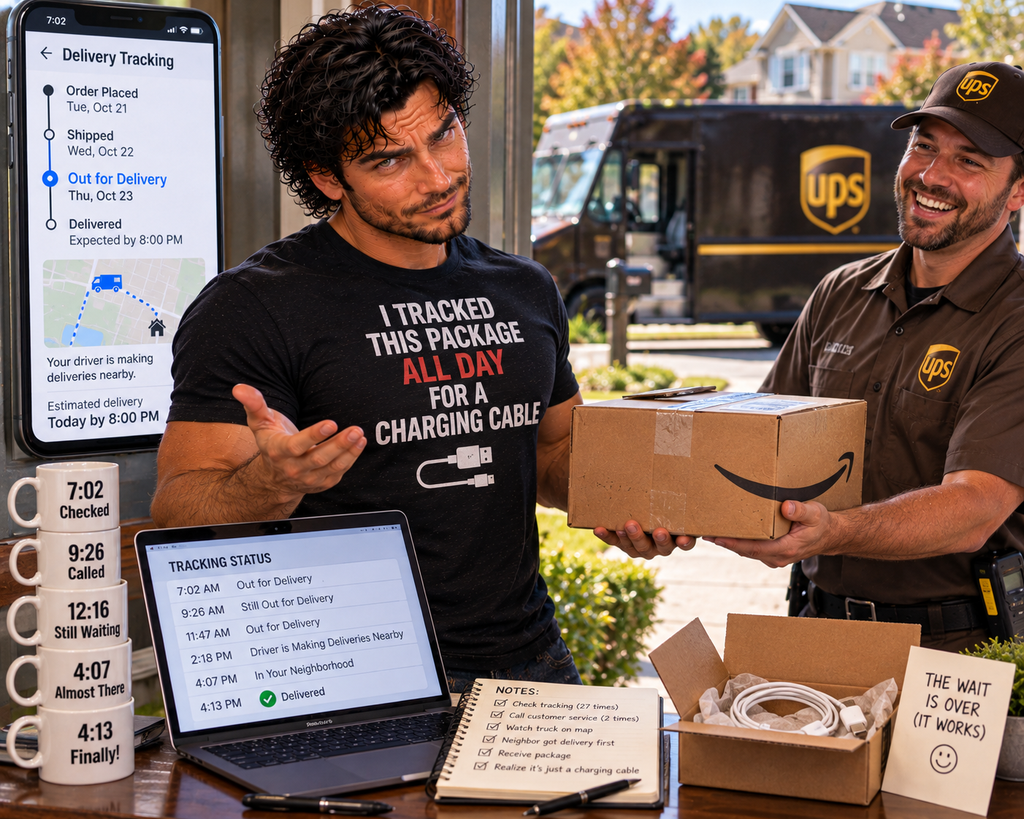
Hot Josh and the Package Delivery Emergency

I ordered something online.

What it was doesn’t matter.

It was important.

Extremely important.

Important enough that I selected two-day shipping.

Not three-day shipping.

Not standard shipping.

Two days.

Because patience is a virtue I prefer other people to practice.

The package was scheduled to arrive Thursday.

Excellent.

I woke up at 7:02 a.m.

Checked my phone.

And there it was.

OUT FOR DELIVERY

Three beautiful words.

Out.

For.

Delivery.

I smiled.

My package was on its way.

I imagined a delivery truck pulling out of a warehouse.

A driver gripping the steering wheel.

My package sitting securely in the back.

Possibly surrounded by other packages.

But clearly the most important one.

At 7:45, I checked the tracking page.

Still out for delivery.

At 8:15, I checked again.

No change.

At 8:47, I refreshed.

Nothing.

This was concerning.

At 9:03, I received an update.

YOUR PACKAGE IS EXPECTED BY 8:00 P.M.

Eight.

P.M.

I stared at the screen.

That was nearly eleven hours away.

What exactly did “out for delivery” mean?

Was it out sightseeing?

Visiting relatives?

Taking a scenic tour of the metropolitan area?

I opened the tracking map.

There was a little truck icon.

Beautiful.

Technology.

Transparency.

Accountability.

The truck appeared approximately four miles away.

Four miles.

I could drive there in eight minutes.

Possibly six.

Depending on traffic.

And enthusiasm.

I watched the icon.

It moved.

Closer.

Closer.

Then turned left.

Away from me.

I sat upright.

“Where are you going?”

The truck continued moving.

In the wrong direction.

I refreshed the page.

Still wrong.

I considered whether the driver had received incorrect instructions.

Perhaps the navigation system was malfunctioning.

Perhaps the truck was lost.

Perhaps the company hadn’t explained that my package was the priority.

I called customer service.

“Thank you for calling. How can I help you?”

“Yes. I’m calling about a package.”

“Of course. Do you have the tracking number?”

I provided it.

She checked.

“Your package is out for delivery.”

“I know.”

“Great! It should arrive by eight tonight.”

“That’s the problem.”

She paused.

“What’s the problem?”

“It’s currently 9:26 in the morning.”

“Yes?”

“And the package is four miles away.”

“Okay.”

“So why isn’t it here?”

She explained that drivers follow assigned routes.

Routes.

Interesting.

Apparently my delivery was being governed by a prearranged sequence of events.

“Can the driver change the route?”

“Unfortunately, we can’t request that.”

“Why?”

“Because the driver has many deliveries to complete.”

I nodded.

“Understood.”

Then asked the obvious question.

“How many of those deliveries are mine?”

She paused.

“Just this one, I believe.”

“Exactly.”

Silence.

Powerful silence.

I continued.

“So the driver is prioritizing packages belonging to strangers over a package belonging to me.”

“Sir, all customers are important.”

I smiled.

“Of course. But some customers are currently on the phone.”

She laughed.

I didn’t.

Well.

Maybe a little.

“Can I speak with the driver?”

“I’m sorry, but we can’t connect customers directly with drivers.”

“Can you send a message?”

“No.”

“Can I wave at the truck if I see it?”

She laughed again.

“You’re welcome to wave.”

Progress.

At least one communication channel remained available.

I thanked her.

Hung up.

And returned to the tracking map.

10:14.

The truck was now six miles away.

Six.

It had increased the distance between us.

This was no longer delivery.

This was avoidance.

I made coffee.

Opened my laptop.

Attempted to work.

Failed.

Checked tracking.

11:02.

Still out for delivery.

11:47.

No change.

12:16.

The truck was three miles away.

I stood up.

Finally.

The operation was back on track.

Then the truck turned again.

Away.

I stared at the screen.

“Unbelievable.”

At 1:30, I decided to take matters into my own hands.

I walked outside.

Looked down the street.

No truck.

Looked the other direction.

No truck.

A postal vehicle passed.

Wrong company.

I waved anyway.

The driver waved back.

At least somebody understood customer relations.

At 2:18, I received another notification.

YOUR DRIVER IS MAKING DELIVERIES NEARBY.

Nearby.

A wonderfully vague word.

Nearby could mean two houses.

Two streets.

Two towns.

Apparently geography had become subjective.

I refreshed the map.

The truck was less than a mile away.

Excellent.

I stood by the front window.

Waiting.

Watching.

Ready.

Then I saw it.

A delivery truck.

Coming down the street.

My heart raced.

It approached.

Slowed.

And stopped.

Across the street.

At my neighbor’s house.

I watched the driver exit.

Carry a package to the porch.

Take a photo.

Return to the truck.

Then drive away.

Without stopping at my house.

I couldn’t believe it.

He had been right there.

Right.

There.

I stepped outside.

The truck disappeared around the corner.

I considered chasing it.

Then remembered I was wearing slippers.

And had absolutely no intention of exercising for a delivery.

I returned inside.

Called customer service again.

A different representative answered.

“How may I help you?”

“I believe your driver has overlooked my residence.”

She checked the tracking.

“Your package is still out for delivery.”

“Yes, but he just delivered to my neighbor.”

“Okay.”

“And didn’t deliver to me.”

“That can happen depending on how the packages are organized in the truck.”

I froze.

“Organized?”

“Yes.”

“So you’re telling me my package may be physically inside the truck, but the driver can’t deliver it because it’s not in the correct organizational sequence?”

“That’s possible.”

I leaned back.

This was extraordinary.

A truck.

A package.

A house.

All within approximately fifty feet of one another.

And somehow logistics had defeated common sense.

I thanked her.

Again.

At 4:07, the truck returned to my neighborhood.

I saw it on the map.

Two streets away.

Then one.

Then finally…

My street.

I stood.

Walked to the front door.

Opened it.

And waited.

The truck approached.

Slowed.

Stopped.

The driver stepped out.

Holding a package.

My package.

I smiled.

He walked toward me.

“Good afternoon!”

“Good afternoon.”

He handed me the box.

“Here you go.”

I accepted it.

Then looked at my watch.

4:13 p.m.

Nine hours and eleven minutes after my first tracking check.

I looked at him.

“Busy day?”

He laughed.

“Very.”

“I noticed.”

He smiled.

“Been waiting for this?”

“Since approximately seven this morning.”

He laughed again.

“Well, it’s here now.”

I nodded.

“Yes. But I have a question.”

“Sure.”

“Why did you deliver to my neighbor six hours ago and not stop here?”

He looked confused.

“Six hours ago?”

“Earlier this afternoon.”

“Oh. Different packages are loaded for different sections of the route.”

I nodded.

“Interesting.”

He continued.

“We follow the route the system gives us.”

There it was again.

The system.

The invisible authority responsible for everything.

I considered explaining my entire morning.

The tracking.

The phone calls.

The map.

The emotional journey.

Then I looked at the driver.

He was sweating.

Tired.

Clearly working hard.

And still had a truck full of packages.

I stopped.

“Well, thank you.”

He smiled.

“You’re welcome. Have a good one!”

He returned to the truck.

I carried the package inside.

Placed it on the kitchen counter.

Grabbed a pair of scissors.

Opened the box.

Removed the packing material.

And finally revealed the item I’d been waiting for all day.

A phone charging cable.

A charging cable.

Not a medical device.

Not emergency supplies.

Not a critical replacement part.

A cable.

For a phone that was already charging perfectly well using another cable.

I stared at it.

Then at the clock.

Then at the shipping box.

I had spent nine hours monitoring the movement of a charging cable.

Called customer service twice.

Watched a delivery truck travel around town.

And nearly confronted a driver over a product I didn’t actually need immediately.

I picked up the cable.

Examined it.

Then plugged it into my phone.

It worked.

Beautifully.

Exactly like the old one.

I sat down.

Opened my laptop.

And returned to the work I’d been neglecting all day.

Then my phone buzzed.

HOW WAS YOUR DELIVERY EXPERIENCE?

A survey.

Of course.

I opened it.

Five stars.

I selected five.

The driver had done his job.

The package arrived on time.

Nothing was damaged.

Everything was exactly as promised.

Then I saw the comment box.

I smiled.

And typed:

Delivery was successful. However, I recommend reconsidering the definition of “out for delivery” for customers who interpret that phrase as “coming directly to my house.”

I submitted it.

Then looked at the charging cable.

And laughed.

The lesson?

Hot Josh believes that when a package is out for delivery, it should be delivered.

Preferably immediately.

Preferably before breakfast.

Preferably without visiting seventeen other houses first.

But sometimes the world doesn’t revolve around your package.

Even when you’ve spent the entire day tracking it like a missing person.

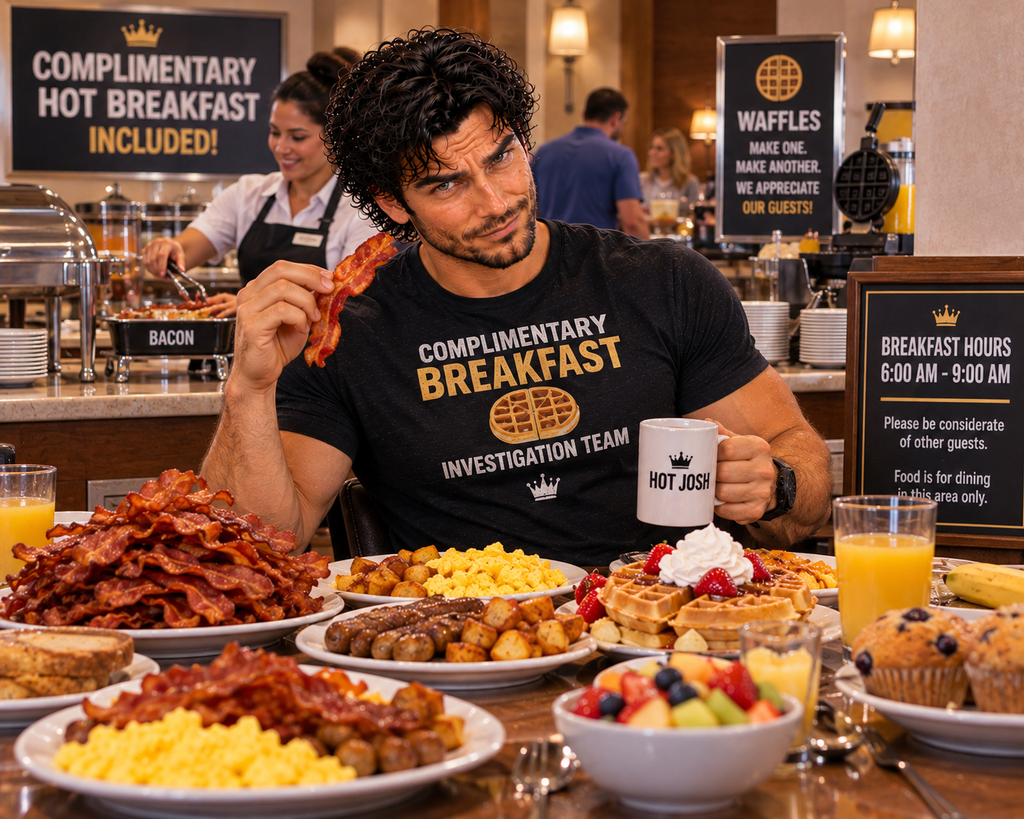
Hot Josh and the Hotel Breakfast Buffet Investigation

I believe breakfast is the most important meal of the day.

Not necessarily because of nutrition.

Because it’s the first opportunity someone has to disappoint me.

And on this particular morning, I had high expectations.

I was staying at a hotel that advertised:

COMPLIMENTARY HOT BREAKFAST INCLUDED!

Included.

A beautiful word.

Complimentary.

An even better word.

I had paid $189 for the room.

Naturally, I intended to recover a reasonable portion of that investment through breakfast.

I arrived downstairs at 8:07 a.m.

The breakfast area was magnificent.

Scrambled eggs.

Bacon.

Sausage.

Potatoes.

Cereal.

Yogurt.

Fruit.

Toast.

Bagels.

And, standing proudly in the corner, a waffle machine.

I had found paradise.

I selected a plate.

A large plate.

Not because I was particularly hungry.

Because efficiency matters.

I approached the bacon.

Six strips.

Then sausage.

Four links.

Scrambled eggs.

A respectable mountain.

Potatoes.

Enough to support the eggs.

I returned to my table.

Ate.

Enjoyed.

And immediately returned for another plate.

The bacon was excellent.

Crispy.

Perfectly cooked.

A triumph of hotel hospitality.

On my third trip, I noticed something concerning.

The bacon tray was empty.

I looked around.

No employee.

No replacement tray.

No indication of when additional bacon might arrive.

This was unacceptable.

I approached the breakfast attendant.

“Excuse me.”

She smiled.

“Good morning!”

“Good morning. We appear to have a bacon emergency.”

She laughed.

“Oh, I’ll bring some more out.”

“Excellent.”

I returned to my table.

Waited.

Three minutes.

Five minutes.

Seven minutes.

No bacon.

I began considering whether the situation qualified as a service interruption.

Finally, the attendant returned with a fresh tray.

Beautiful.

I approached immediately.

Then noticed the gentleman in front of me.

He was taking bacon.

Lots of bacon.

Strip after strip.

I watched.

Six.

Eight.

Ten.

Twelve.

He was building something.

Possibly a cabin.

I cleared my throat.

He turned.

“Yes?”

“Are you expecting company?”

He looked confused.

“No.”

“Interesting.”

He continued loading his plate.

I looked at the tray.

Then at him.

Then back at the tray.

“We’re sharing a finite resource.”

He laughed.

“It’s a buffet.”

“Exactly. A buffet. Not a private bacon acquisition program.”

He shrugged.

And walked away.

With fourteen strips.

Fourteen.

I counted.

Of course I counted.

I selected eight strips.

A reasonable amount.

Then returned to my table.

By 8:45, I had completed three plates.

And two waffles.

The waffles were magnificent.

Golden.

Crispy.

Covered in butter and syrup.

Then I noticed the clock.

8:52.

Breakfast ended at nine.

Nine.

Seven minutes.

I had not been informed that my complimentary dining privileges were approaching termination.

I approached the attendant.

“Excuse me. What happens at nine?”

She smiled.

“We close breakfast.”

“Immediately?”

“Yes.”

“Even if people are still eating?”

“Oh, you can finish what you have.”

I nodded.

“Excellent.”

Then I asked the important question.

“What if I haven’t finished selecting what I have?”

She laughed.

“Sir?”

“Is there a final opportunity to acquire additional breakfast?”

She looked at the clock.

“You’ve got a few minutes.”

A few minutes.

This was now a timed event.

I returned to the buffet.

Selected another waffle.

Added potatoes.

A banana.

Two muffins.

And three strips of bacon.

Then I noticed the orange juice dispenser.

I filled a glass.

Then another.

Not because I needed two glasses.

Because I wasn’t certain whether refills would remain available after nine.

At 8:59, I returned to my table.

Success.

At 9:01, the attendant began removing the serving trays.

I watched.

The eggs disappeared.

The sausage disappeared.

The bacon disappeared.

The waffle batter was removed.

A culinary civilization was collapsing before my eyes.

I looked at my plate.

Then at the buffet.

Then back at my plate.

I had survived.

Barely.

At 9:12, I was still eating.

The attendant approached.

“Everything good?”

“Excellent.”

She smiled.

“Glad you enjoyed it.”

“I did have one question.”

“Sure.”

“Is there a limit on how much complimentary breakfast a guest can consume?”

She laughed.

“Not really.”

“Interesting.”

“Why?”

I looked at my collection of plates.

Four.

Possibly five.

The evidence was becoming difficult to conceal.

“Just researching the policy.”

She smiled.

“Well, we just ask guests to be considerate of others.”

Reasonable.

Fair.

Completely understandable.

Then she added:

“And we ask that guests don’t take food back to their rooms.”

I froze.

“Excuse me?”

“Breakfast is meant to be enjoyed here.”

I looked at the two muffins beside my plate.

Then at the banana.

Then at my room key.

This was developing into a serious jurisdictional issue.

“So the breakfast is complimentary…”

“Yes.”

“…but only within this room?”

“That’s right.”

“Interesting.”

She waited.

I continued.

“Does the hotel own the muffin after I select it?”

She laughed.

“No.”

“Then why can’t I transport it?”

“It’s just our policy.”

There it was.

The phrase that has launched a thousand customer service investigations.

It’s just our policy.

I picked up a muffin.

Looked at it.

Then at her.

“What if I start eating it here and finish it upstairs?”

She laughed.

“I guess that’s fine.”

A loophole.

Beautiful.

I took one bite.

Then placed the muffin on a napkin.

“Excellent. This muffin is now in transit.”

She laughed so hard she had to turn away.

I gathered my belongings.

Picked up my coffee.

And headed toward the elevator.

Then I noticed the hotel manager standing near the front desk.

He smiled.

“Good morning! How was breakfast?”

I stopped.

An opportunity.

“Very good.”

“Wonderful.”

“Although I have some concerns about the closing procedure.”

He raised an eyebrow.

“Oh?”

“Your breakfast closes at nine.”

“Yes.”

“But checkout isn’t until eleven.”

“Correct.”

“So there’s a two-hour period during which I’m still a paying guest but no longer entitled to breakfast.”

He considered this.

“Well, breakfast is served from six to nine.”

I nodded.

“Right. But my room is available until eleven.”

“Yes.”

“Interesting.”

He smiled.

“Would you like us to extend breakfast until eleven?”

I looked at him.

He looked at me.

For one glorious moment, I thought we were negotiating.

Then he laughed.

I laughed too.

Mostly because I realized he was joking.

Mostly.

“No,” I said. “But perhaps you could consider a late-breakfast option.”

He nodded.

“That’s actually not a bad suggestion.”

Finally.

Progress.

Recognition.

The possibility of meaningful institutional reform.

I entered the elevator.

Pressed my floor.

And took another bite of the muffin.

Then something occurred to me.

I had spent nearly an hour eating breakfast.

Four plates.

Two waffles.

Several glasses of orange juice.

And enough bacon to make a cardiologist request an emergency consultation.

I had enjoyed every minute.

The food was excellent.

The staff was friendly.

The hotel had delivered exactly what it promised.

Complimentary breakfast.

And yet somehow, I had managed to turn the entire experience into a debate about property rights, scheduling, and muffin transportation.

I looked at the muffin.

Then at my reflection in the elevator mirror.

And smiled.

Some people see a free breakfast.

Hot Josh sees an opportunity to examine the limits of hospitality.

The lesson?

Hot Josh believes complimentary breakfast should be enjoyed to its fullest.

But there’s a difference between appreciating generosity and testing how much generosity you can extract.

And apparently, that difference is approximately four plates, two waffles, and one muffin with an interstate travel permit.

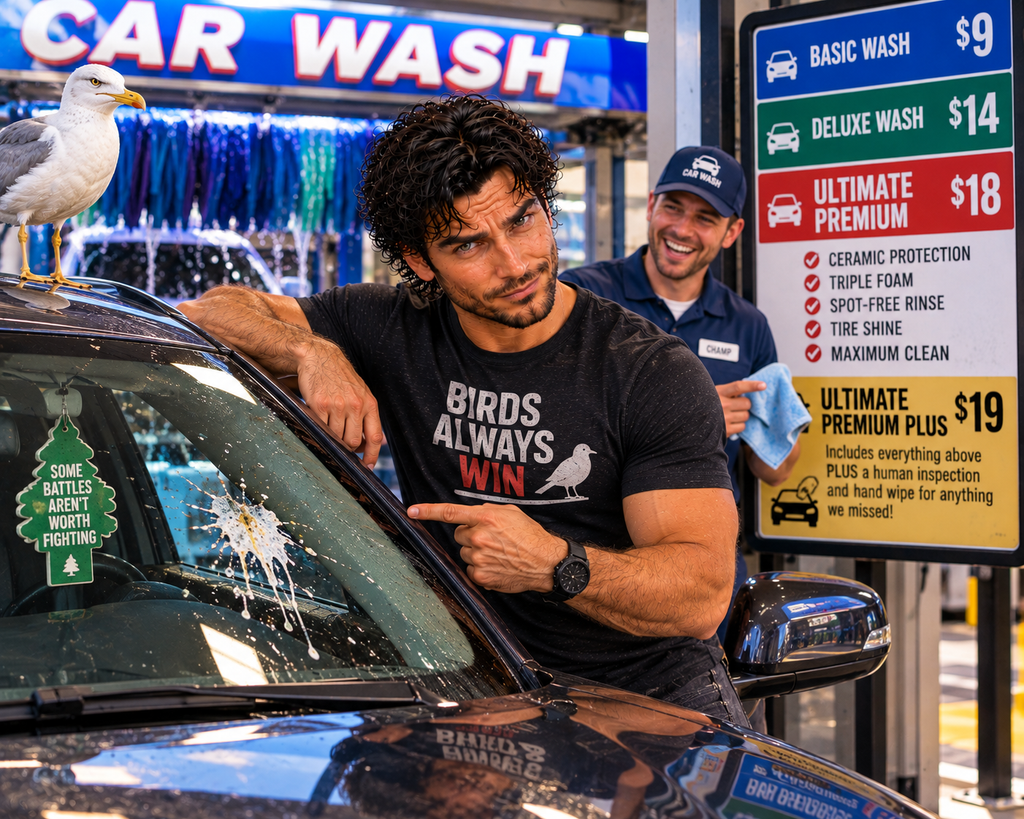
Hot Josh and the Automatic Car Wash Hostage Situation

I take pride in my appearance.

My hair.

My clothes.

My shoes.

My car.

Everything should look like it belongs to someone who has his life together.

Whether I actually have my life together is a separate discussion.

So when I noticed a bird had deposited something unpleasant directly in the middle of my windshield, I took it personally.

Not because birds understand property rights.

Clearly, they don’t.

But because this particular bird had selected my vehicle from an entire parking lot.

An intentional act.

Possibly targeted.

I drove to the automatic car wash.

The sign advertised three packages.

BASIC WASH: $9

DELUXE WASH: $14

ULTIMATE PREMIUM: $18

Naturally, I selected Ultimate Premium.

I’m not a basic person.

And I refuse to subject my car to basic treatment.

The screen displayed my purchase.

ULTIMATE PREMIUM WASH

CERAMIC PROTECTION

TRIPLE FOAM

SPOT-FREE RINSE

TIRE SHINE

MAXIMUM CLEAN

Maximum.

An important word.

I paid.

The gate opened.

I drove forward.

A mechanical voice instructed me to stop.

I stopped.

Then it instructed me to place the vehicle in neutral.

I complied.

Then it told me to release the brake.

I complied again.

For eighteen dollars, I was receiving an astonishing number of instructions.

The conveyor belt pulled my car forward.

The machinery came alive.

Water blasted the windshield.

Colorful foam covered the windows.

Huge brushes spun around the vehicle.

Blue lights.

Purple lights.

Green lights.

Honestly, it was more entertaining than some concerts I’ve attended.

For approximately four minutes, I sat inside a vibrating disco operated by industrial plumbing.

Then the dryers activated.

Massive jets of air blasted the vehicle.

The car emerged.

Clean.

Shiny.

Beautiful.

Almost.

I pulled into the inspection area.

Stepped out.

Walked around the car.

The tires looked fantastic.

The paint gleamed.

The windows sparkled.

Then I saw it.

The bird dropping.

Still there.

Smaller.

But there.

Directly in the middle of my windshield.

Unbelievable.

I stared at it.

It stared back.

This bird had apparently used military-grade adhesive.

I returned to the payment kiosk.

An attendant approached.

“Everything okay?”

“No.”

He looked concerned.

“What’s wrong?”

I pointed toward my windshield.

“Your maximum clean appears to have a minimum exception.”

He looked at the spot.

“Oh, yeah. Sometimes those need a little extra attention.”

I nodded.

“Interesting.”

He waited.

I continued.

“So the Ultimate Premium package doesn’t remove everything?”

“Not always.”

“Then why is it called Ultimate?”

He laughed.

“That’s just the name of the package.”

“Ah.”

I folded my arms.

“So Ultimate is more of an aspiration.”

He smiled.

“I guess you could say that.”

“And Maximum Clean?”

“That’s our top wash.”

“Not maximum cleanliness?”

He laughed again.

“Sir, it’s a car wash.”

I looked toward the machinery.

Then at the windshield.

Then back at him.

“I paid eighteen dollars to have a machine attack my vehicle with approximately six thousand gallons of enthusiasm, and one bird has defeated the entire operation.”

He was laughing now.

I wasn’t finished.

“I’d like a second wash.”

“Sure. We can run you through again.”

Excellent.

A reasonable solution.

I returned to my car.

Drove around the building.

Entered the wash again.

The machinery activated.

More water.

More foam.

More spinning brushes.

More colorful lights.

I was beginning to recognize the sequence.

By the second purple light, I felt like a season-ticket holder.

The dryers blasted.

The gate opened.

I emerged.

Pulled over.

Inspected.

And there it was.

Still there.

The bird dropping had survived two premium washes.

At this point, I was no longer dealing with dirt.

I was dealing with an opponent.

I returned to the attendant.

He saw me approaching.

His smile disappeared.

“Still there?”

I nodded.

“Still there.”

He walked over.

Looked at the windshield.

Then did something extraordinary.

He took a damp microfiber cloth.

Wiped the spot.

Once.

And it disappeared.

Completely.

I stared.

He stared.

We both stared at the clean windshield.

Four seconds.

One cloth.

Problem solved.

I looked toward the enormous automatic car wash.

The conveyor belt.

The spinning brushes.

The colorful foam.

The high-pressure jets.

The industrial dryers.

Then back at the attendant.

“So…”

He was already smiling.

“…you’re telling me the eighteen-dollar Ultimate Premium system was defeated by a damp rag?”

He burst out laughing.

I remained composed.

Externally.

Internally, I was reviewing every decision that had brought me here.

He handed me the cloth.

“Sometimes you just need to wipe it.”

I nodded slowly.

“Revolutionary.”

He laughed harder.

I looked at the cloth.

Then at the windshield.

Then at the car wash.

“I have a suggestion.”

“What’s that?”

“Add a nineteen-dollar package.”

He raised an eyebrow.

“What would that include?”

I held up the cloth.

“This.”

He nearly doubled over laughing.

I continued.

“Call it Ultimate Premium Plus.”

“Okay.”

“Include everything from the eighteen-dollar package.”

“Right.”

“Then have a human being inspect the vehicle and remove anything the machine missed.”

He nodded.

“Actually, that’s not a bad idea.”

I smiled.

Finally.

Recognition.

“Of course it isn’t.”

I handed back the cloth.

Then remembered something.

“One more question.”

“Sure.”

“Do you offer a satisfaction guarantee?”

“Yes.”

“Excellent.”

“Are you satisfied now?”

I looked at my spotless windshield.

Then at my gleaming car.

Then at the attendant.

“Almost.”

He sighed.

“What else?”

“I’ve now been through the car wash twice.”

“Yes.”

“And spent approximately twenty minutes resolving this.”

“Okay.”

“Does that qualify me for a loyalty reward?”

He laughed.

“No.”

“Complimentary air freshener?”

He considered it.

Then reached into a small box.

Pulled out a pine-scented air freshener.

And handed it to me.

“Here.”

Victory.

At last.

I thanked him.

Returned to my car.

And drove away.

The vehicle looked magnificent.

The windshield was spotless.

The tires gleamed.

And a tiny cardboard tree swung proudly from my rearview mirror.

I felt accomplished.

Then, at the very next traffic light, something landed on my hood.

SPLAT.

I looked up.

A bird sat on the traffic signal.

Watching.

I stared at it.

The bird stared back.

I slowly lowered my window.

“Don’t even think about it.”

The bird flew away.

I looked at my hood.

Another dropping.

Fresh.

Prominent.

Absolutely deliberate.

I considered turning around.

Then I looked at the air freshener.

Smelled the artificial pine.

And made a decision.

Some battles aren’t worth fighting.

Especially when your opponent can fly.

The lesson?

Hot Josh believes paying for the Ultimate Premium experience should produce ultimate premium results.

But sometimes the most sophisticated technology in the world can’t replace a little common sense.

And sometimes, no matter how much you pay, a bird still gets the final word.

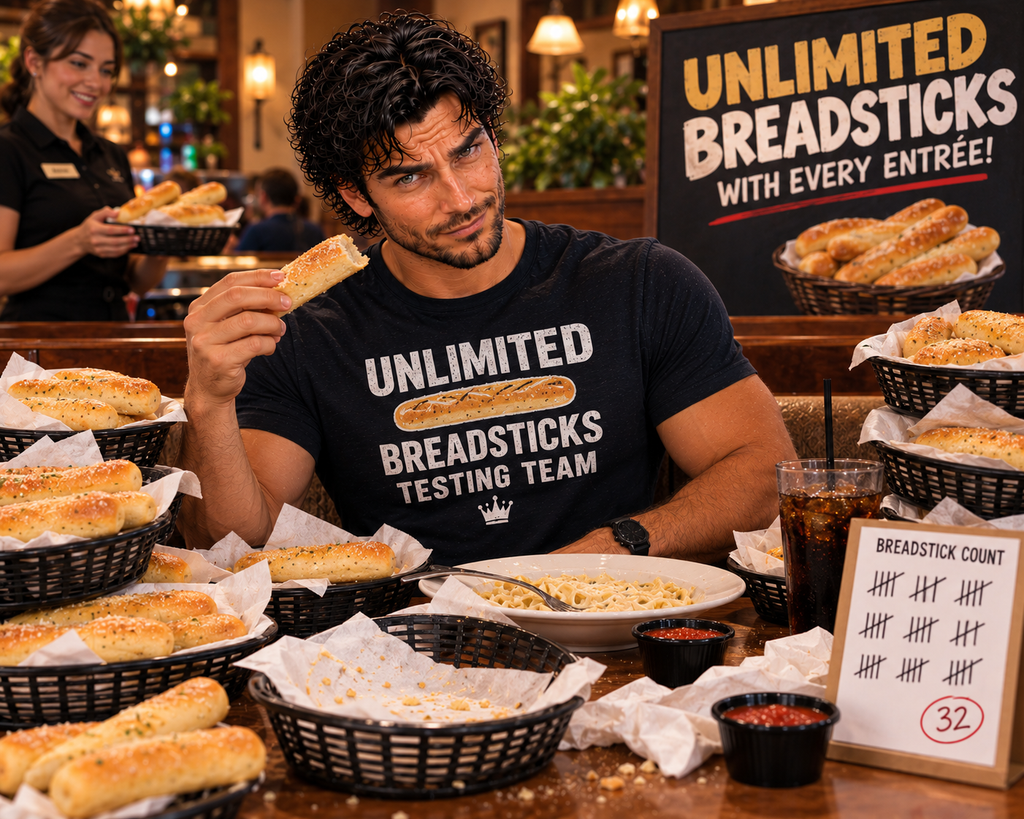
Hot Josh and the Unlimited Breadstick Investigation

I believe in reading the fine print.

Not because I’m suspicious.

Because I’ve learned that the most important words in advertising are usually followed by an asterisk.

So when I saw the sign outside the restaurant, I was intrigued.

UNLIMITED BREADSTICKS WITH EVERY ENTRÉE!

Unlimited.

A beautiful word.

A powerful word.

A word that, mathematically speaking, means there is no limit.

I entered.

“Table for one, please.”

The hostess smiled.

“Right this way.”

I followed her to a booth.

Comfortable.

Private.

Excellent breadstick visibility.

A server approached.

“Can I start you off with something to drink?”

“Water, please.”

“Of course.”

“And I have a question.”

“Sure!”

“Are the breadsticks really unlimited?”

She smiled.

“Yes, they are.”

“Excellent.”

She handed me the menu.

I opened it.

Pasta.

Chicken.

Seafood.

Salads.

All perfectly respectable options.

But I wasn’t here for those.

I was here to investigate a promise.

I ordered the chicken Alfredo.

Then leaned forward.

“And I’d like to begin the breadstick program immediately.”

She laughed.

“Absolutely.”

A few minutes later, she returned with a basket.

Four breadsticks.

Four.

I counted them twice.

“Here you go!”

I looked at the basket.

Then at her.

“Is this the unlimited portion?”

She laughed.

“We’ll bring more whenever you want.”

Interesting.

So unlimited didn’t mean all at once.

It meant installments.

I ate the first breadstick.

Delicious.

Second.

Excellent.

Third.

Still excellent.

Fourth.

A respectable finish.

I pressed the call button.

There wasn’t one.

Unfortunate.

I waited until the server passed.

“Excuse me. I’d like another basket.”

“Of course!”

She returned with four more.

Eight total.

Progress.

I began documenting the experience.

Not on paper.

Mentally.

I have a remarkable memory when free food is involved.

By the third basket, I’d consumed twelve breadsticks.

The chicken Alfredo arrived.

Beautiful.

Creamy.

Perfectly prepared.

I took two bites.

Then returned to the breadsticks.

The server noticed.

“Everything okay with your pasta?”

“Wonderful.”

“Great!”

“I’m conducting a separate evaluation.”

She looked confused.

“Of what?”

“Your unlimited breadstick policy.”

She laughed.

“Oh, okay.”

I requested another basket.

Sixteen breadsticks.

Now we were approaching meaningful numbers.

At basket five, the server hesitated.

“Are you sure?”

I looked at her.

“About?”

“More breadsticks.”

“Yes.”

She smiled.

“Okay.”

Basket five arrived.

Twenty breadsticks.

I had now eaten enough bread to concern a nutritionist.

But this wasn’t about hunger anymore.

It was about principle.

At basket six, the manager appeared.

He approached my table.

“Good evening! How’s everything?”

“Excellent.”

“Glad to hear it.”

“I do have a question.”

“Sure.”

“At what point does unlimited become limited?”

He laughed.

“Excuse me?”

I pointed toward the empty baskets.

“Your sign says unlimited.”

“That’s correct.”

“So theoretically, I could continue ordering breadsticks indefinitely.”

He smiled.

“As long as you’re dining with us.”

Aha.

There it was.

A condition.

I leaned back.

“Define dining.”

He blinked.

“Well, eating a meal.”

“I ordered a meal.”

“Yes.”

“I’m still here.”

“Yes.”

“And I’m still eating.”

He looked at the empty baskets.

“Clearly.”

I smiled.

“So we’re in agreement.”

He laughed.

“I suppose we are.”

Then he added something unexpected.

“We do ask that guests not take unlimited breadsticks home.”

I froze.

“Home?”

“Yes.”

“Interesting.”

He waited.

I continued.

“So the breadsticks are unlimited geographically, but only within this building?”

He laughed.

“Something like that.”

I nodded.

“Then the restaurant is essentially a breadstick sanctuary.”

He laughed harder.

“I’ve never heard it described that way.”

“You’re welcome.”

He returned to the kitchen.

I continued eating.

At basket seven, I began slowing down.

Twenty-eight breadsticks.

The pasta sat mostly untouched.

My stomach was filing formal objections.

I ignored them.

Basket eight arrived.

Thirty-two.

I stared at the breadsticks.

They stared back.

We had reached an impasse.

I picked one up.

Took a bite.

And realized something.

I was no longer enjoying breadsticks.

I was enduring them.

This was concerning.

Because unlimited breadsticks were supposed to represent freedom.

Abundance.

Joy.

Not a personal endurance competition against baked dough.

I put the breadstick down.

The server approached.

“Would you like another basket?”

I looked at her.

Then at the breadsticks.

Then at the pasta.

Then at the ceiling.

“No.”

She smiled.

“Are you sure?”

I nodded.

“Yes.”

She looked surprised.

I understood.

After thirty-two breadsticks, surrender was unexpected.

I finished what I could of my pasta.

Requested the check.

Paid.

And stood up.

Slowly.

Very slowly.

My body had become approximately forty percent garlic.

As I approached the exit, the manager spotted me.

“How was everything?”

“Excellent.”

“Glad to hear it.”

I paused.

“Your unlimited breadstick policy passed.”

He laughed.

“Good to know.”

“But I do have one recommendation.”

“What’s that?”

“Consider adding a warning.”

He raised an eyebrow.

“What kind of warning?”

I looked him directly in the eye.

Unlimited does not mean advisable.

He laughed.

I walked outside.

The evening air was cool.

Refreshing.

Necessary.

I sat in my car for several minutes.

Not because I was tired.

Because my digestive system had requested a meeting.

And for once, I decided to listen.

The lesson?

Hot Josh believes businesses should honor their promises.

If you advertise unlimited, you should mean unlimited.

But sometimes the only person capable of imposing a reasonable limit on Hot Josh…

is Hot Josh.

And apparently, that limit is somewhere around thirty-two breadsticks.

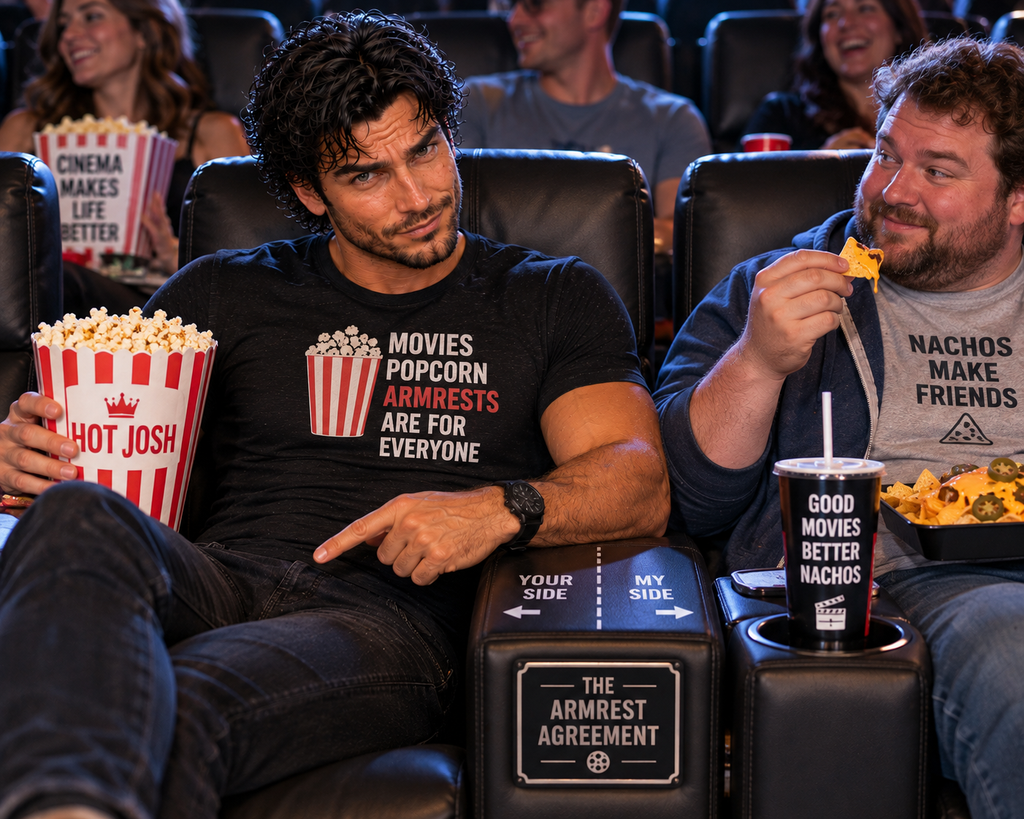
Hot Josh and the Movie Theater Armrest Agreement

I arrived at the movie theater at 6:42 p.m.

The movie started at seven.

Perfect timing.

Not early enough to sit through twenty minutes of advertisements.

Not late enough to miss anything important.

I purchased my ticket.

Seat F12.

Center section.

Excellent viewing angle.

Strategically selected.

I also purchased a large popcorn.

A large soda.

And a box of candy that cost approximately the same as a small appliance.

Total concession expenses: $24.87.

I didn’t complain.

Out loud.

I entered the auditorium.

Found Row F.

Located Seat 12.

And sat down.

Beautiful.

Comfortable.

Reclining seat.

Cupholder.

Two armrests.

Everything a civilized person could want.

Then someone sat beside me.

Seat F13.

A man carrying nachos.

Large nachos.

The kind that require architectural planning.

He settled into his seat.

Placed his drink in the cupholder.

Adjusted his jacket.

And immediately claimed the armrest between us.

The entire armrest.

Elbow.

Forearm.

Hand.

Full occupation.

I looked at it.

Then at him.

Then back at the armrest.

Interesting.

Apparently we were beginning with territorial expansion.

I waited.

Perhaps he would notice.

Perhaps he’d adjust.

Perhaps common courtesy would prevail.

Thirty seconds passed.

Nothing.

I cleared my throat.

He looked at me.

“Everything okay?”

“Just evaluating the seating arrangement.”

He nodded.

“Cool.”

Then turned back toward the screen.

Cool?

No.

This was not cool.

This was a property dispute.

I examined the situation.

I had an armrest on my left.

He had an armrest on his right.

Between us sat one shared armrest.

Three armrests.

Two people.

A mathematical problem.

I leaned slightly toward him.

“Excuse me.”

He turned.

“Yeah?”

“How do you feel about shared infrastructure?”

He blinked.

“What?”

“Shared infrastructure.”

“Like roads?”

“Exactly.”

He looked confused.

I pointed toward the armrest.

“This.”

He stared at it.

Then at me.

“What about it?”

“I believe we need an agreement.”

He laughed.

“An agreement?”

“Yes.”

“For the armrest?”

“Correct.”

He looked around as if searching for hidden cameras.

There were none.

This was a serious negotiation.

“I was thinking we could divide it.”

He examined the armrest.

“How?”

“Front and back.”

He looked at me.

I continued.

“You take the front half. I’ll take the back.”

He considered this.

Then shook his head.

“That’s weird.”

Interesting.

Apparently fairness was weird.

“Would you prefer alternating intervals?”

“What?”

“Fifteen minutes each.”

He laughed.

“Dude, it’s an armrest.”

“Exactly. Which is why this should be easy.”

He moved his arm.

“Fine. Take it.”

Victory.

Immediate.

Decisive.

Almost suspiciously easy.

I placed my elbow on the armrest.

Comfortable.

Perfect.

Justice restored.

Then the previews began.

Loud.

Very loud.

Explosions.

Car chases.

People screaming.

A helicopter appeared to crash through approximately seventeen buildings.

All during an advertisement for an upcoming movie.

I leaned back.

Relaxed.

Enjoyed my popcorn.

Then I noticed something.

My neighbor was struggling with his nachos.

He had the tray balanced awkwardly on his lap.

His drink occupied one cupholder.

His other hand held a cheese-covered chip.

He needed somewhere to rest his elbow.

The armrest.

My armrest.

The one I’d just negotiated.

I looked at him.

He looked at me.

Our eyes met.

He didn’t ask.

He simply continued balancing his nachos.

I considered offering him half.

Then remembered our earlier negotiations.

He had voluntarily surrendered the territory.

Legally, emotionally, and spiritually, it was mine.

But then something unexpected happened.

He offered me a nacho.

“Want one?”

I stared.

A nacho.

A peace offering.

A diplomatic breakthrough.

I accepted.

“Thank you.”

He nodded.

“No problem.”

I moved my elbow.

“Here. You can use the armrest.”

He smiled.

“Thanks.”

And just like that, international relations improved.

The movie started.

For the next forty minutes, everything was peaceful.

Then the man in front of me reclined his seat.

All the way.

Now wait a minute.

I looked at the back of his head.

Then at my knees.

Then at the reclining mechanism.

Apparently this theater had an entirely separate territorial dispute developing.

I leaned forward.

“Excuse me.”

He turned.

“Yeah?”

“How far back does that seat go?”

He looked confused.

“All the way.”

“I noticed.”

He stared.

I continued.

“Are you planning to occupy all available airspace behind your seat?”

He laughed.

“What?”

“Just trying to understand the boundaries.”

He turned back around.

And remained fully reclined.

I sat there.

Processing.

Then I looked at the button on my own armrest.

Recline.

Interesting.

I pressed it.

My seat moved backward.

Slowly.

Smoothly.

Beautifully.

I reclined all the way.

Suddenly, I had plenty of room.

The man in front of me hadn’t invaded my space.

He had simply understood the equipment better than I did.

An inconvenient revelation.

I settled in.

Enjoyed the movie.

Shared a few more nachos.

And forgot about the armrest entirely.

Until the credits rolled.

The lights came on.

My neighbor stood.

“Good movie.”

“Excellent movie.”

He gathered his belongings.

Then looked at me.

“By the way, you were right.”

I raised an eyebrow.

“About?”

“The armrest.”

I smiled.

Finally.

Recognition.

He continued.

“I always thought the middle armrest should belong to whoever gets there first.”

I nodded.

“Understandable.”

“But splitting it makes sense.”

I stood.

“Exactly.”

He laughed.

“Maybe theaters should put a line down the middle.”

I stopped.

A line.

Down the middle.

Brilliant.

A clearly marked boundary.

No confusion.

No arguments.

No unnecessary negotiations.

I looked at him.

“You may have just solved a national crisis.”

He laughed.

We walked out together.

At the exit, I noticed a customer feedback kiosk.

HOW WAS YOUR EXPERIENCE?

Five stars.

I selected four.

Not because the movie was bad.

Not because the seats were uncomfortable.

Not because the staff had done anything wrong.

But because there was no clearly established armrest policy.

Standards matter.

I entered my comment.

Please consider clearly defining shared armrest usage between adjacent seats. This would prevent unnecessary disputes and improve the overall guest experience.

Then I added:

Also, $24.87 for snacks is a little aggressive.

I submitted the feedback.

Walked outside.

And felt accomplished.

The lesson?

Hot Josh believes buying a movie ticket should include reasonable access to the armrest beside his seat.

But sometimes the best way to resolve a dispute isn’t through negotiation.

It’s through sharing.

Especially when the other person has nachos.

Hot Josh and the Gym Equipment Reservation System

I arrived at the gym at 6:17 p.m.

Peak hour.

Every treadmill was occupied.

The free weights were surrounded by people examining themselves in mirrors.

Someone was taking selfies beside a machine they hadn’t actually used.

And the music was loud enough to qualify as a structural concern.

I had a plan.

Thirty minutes of cardio.

Twenty minutes of weights.

Ten minutes of stretching.

Then home.

Efficient.

Disciplined.

Professional.

I approached my favorite weight machine.

Empty.

Beautiful.

I reached for the handle.

Then I noticed it.

A towel.

Draped over the seat.

Beside it sat a water bottle.

No person.

No movement.

No indication that anyone had used the machine recently.

Just a towel and a bottle.

Apparently gym equipment could now be occupied by accessories.

I looked around.

Nobody approached.

I waited.

Thirty seconds.

One minute.

Two minutes.

Nothing.

Finally, I removed the towel, folded it neatly, and placed it beside the water bottle.

Then I sat down.

I completed my first set.

Excellent.

Second set.

Even better.

Then a voice appeared behind me.

“Hey, man. I’m using that.”

I turned.

A man stood there holding his phone.

He looked irritated.

I looked at the machine.

Then at him.

“You’re using it?”

“Yeah.”

“From where?”

He pointed toward the towel.

“My stuff was there.”

I nodded.

“Yes. I met your towel.”

He stared.

I continued.

“Very quiet. Excellent manners.”

He wasn’t amused.

“I was saving the machine.”

“With a towel?”

“Yes.”

“Interesting.”

I stood.

Looked at the towel.

Then at the water bottle.

“So these two are working out together?”

He sighed.

“Come on, man.”

I gestured toward the empty space where he’d apparently been standing.

“How long were you gone?”

“Just a few minutes.”

“Doing what?”

“Talking to somebody.”

I nodded.

“Networking.”

“What?”

“Important part of fitness.”

He looked confused.

I continued.

“But unfortunately, your equipment reservation system appears to have expired.”

He crossed his arms.

“There’s no reservation system.”

“Exactly.”

Silence.

Beautiful silence.

Finally, he shrugged.

“Whatever. Finish your set.”

Reasonable.

Civilized.

Progress.

I finished.

Wiped down the machine.

And moved on.

Then I noticed something.

Across the gym, another machine had a towel draped over it.

No person.

Just a towel.

I looked toward the free weights.

Another abandoned water bottle.

Then a bench.

A gym bag.

Apparently the entire facility had become a parking lot for personal belongings.

I began investigating.

One machine had been empty for at least five minutes.

Another had a sweatshirt hanging over the handles.

A third had a phone resting on the seat while its owner stood fifteen feet away discussing protein powder.

This was getting ridiculous.

I approached the front desk.

“Excuse me. I need clarification on your equipment reservation policy.”

The employee smiled.

“We don’t reserve equipment.”

“Excellent.”

“It’s first come, first served.”

“Perfect.”

“Is there a problem?”

“Potentially.”

I pointed toward the gym floor.

“People are using towels to establish territorial claims.”

She laughed.

“Yeah, that happens sometimes.”

“Are towels recognized as legal occupants?”

“No.”

“Water bottles?”

“No.”

“Gym bags?”

“No.”

“What about a sweatshirt?”

She laughed harder.

“No.”

I nodded.

“Good. I wanted to make sure we were operating under the same constitution.”

I returned to the workout area.

And that’s when inspiration struck.

If people could reserve equipment with personal belongings…

Why couldn’t I?

I had a towel.

A water bottle.

A phone.

A gym bag.

Four items.

Four potential reservations.

I placed my towel on the bench press.

My water bottle beside the leg press.

My gym bag near the rowing machine.

And my phone on the stretching mat.

Then I stood in the middle of the gym.

Arms crossed.

Surveying my empire.

Four stations.

One Josh.

Unlimited possibilities.

A man approached the bench press.

“Are you using this?”

“Yes.”

He looked at the towel.

“Where are you?”

I pointed toward myself.

“Right here.”

“You’re not on the bench.”

“I’m rotating.”

He stared.

Then another man approached the leg press.

“Is this yours?”

“Temporarily.”

“Are you using it?”

“Strategically.”

A woman approached the stretching mat.

“Is that your phone?”

“Yes.”

“Can you move it?”

“Of course.”

I retrieved the phone.

She took the mat.

Apparently my reservation system had vulnerabilities.

Then the front desk employee appeared.

She looked at my towel.

My water bottle.

My gym bag.

Then at me.

“Josh?”

I smiled.

“Yes?”

“What are you doing?”

“Testing your reservation policy.”

“We don’t have a reservation policy.”

“Exactly. That’s the problem.”

She folded her arms.

“Are you actually using all these machines?”

“Not simultaneously.”

“Then you can’t reserve them.”

I nodded.

“Interesting.”

She waited.

I continued.

“So the towel doesn’t count?”

“No.”

“The water bottle?”

“No.”

“The gym bag?”

“No.”

“Then why was the first guy allowed to do it?”

She smiled.

“He wasn’t.”

There it was.

A breakthrough.

A universal standard.

I had accomplished something.

Not for myself.

For society.

I gathered my belongings.

Returned to one machine.

And finished my workout.

At 7:32, I headed toward the exit.

The employee waved.

“Have a good night!”

I stopped.

Turned around.

And pointed toward the gym floor.

“You’re welcome.”

She laughed.

“For what?”

“Policy reform.”

She shook her head.

I walked out.

Then realized I’d forgotten my water bottle.

I returned inside.

It was sitting beside the leg press.

A man was using the machine.

I approached.

“Excuse me. That’s my water bottle.”

He handed it to me.

“Here.”

I took it.

Then looked at the machine.

“Technically, I was here first.”

He stared.

I smiled.

“Just kidding.”

Mostly.

The lesson?

Hot Josh believes gym equipment should be available to the people actually using it.

Unless Hot Josh is saving it.

Then apparently the rules become considerably more complicated.

Because nothing builds muscle quite like carrying the weight of your own hypocrisy.

Hot Josh and the Coffee Shop Wi-Fi Occupation

I arrived at the coffee shop at 9:14 a.m.

Laptop.

Phone.

Charger.

Headphones.

A notebook.

Three pens.

I was prepared for a productive day.

The coffee shop had everything I needed.

Comfortable chairs.

Free Wi-Fi.

Electrical outlets.

Air conditioning.

Restrooms.

And, most importantly, somebody else paying the electric bill.

I approached the counter.

“Large iced coffee, please.”

“That’ll be $5.75.”

I paid.

She handed me my drink.

“Anything else?”

“No, thank you.”

Transaction complete.

Or so she thought.

I selected a table near the window.

Four chairs.

One electrical outlet.

Excellent natural lighting.

This wasn’t a coffee shop.

This was an executive suite.

I opened my laptop.

Connected to the Wi-Fi.

Plugged in my charger.

Placed my phone beside me.

Arranged my pens.

Opened my notebook.

And began working.

At 10:30, everything was going beautifully.

At 11:15, I had answered seventeen emails.

At noon, I had completed two projects.

At 12:47, I had consumed the last of my coffee.

This was unfortunate.

Not because I wanted more coffee.

Because my unofficial office lease had apparently been paid in full.

I considered purchasing another drink.

Then I looked at the empty cup.

Five dollars and seventy-five cents.

Surely that included more than three hours of occupancy.

I continued working.

At 1:20, an employee approached.

“Hi! Just checking. Are you waiting for anyone?”

I looked at the three empty chairs surrounding me.

“No.”

“Oh, okay. We’re getting pretty busy, and I was wondering if you could move to one of the smaller tables.”

I looked around.

The coffee shop was indeed busy.

People were standing near the counter.

A couple was waiting for a table.

Someone was balancing a laptop on their knees.

Unfortunate.

But I had arrived first.

“I’ve already established my workspace.”

She smiled.

“I understand, but this table seats four.”

“Correct.”

“And there’s only one of you.”

“Also correct.”

“So…”

I gestured toward my laptop.

“I’m currently conducting business.”

She glanced at the screen.

“Okay?”

“Would you ask a company to relocate its headquarters in the middle of the workday?”

She laughed.

“Sir, it’s a coffee shop.”

“That’s what the landlord calls it.”

She stared at me.

I continued.

“I’ve been here since 9:14.”

“Yes.”

“I’ve invested considerable time in this location.”

“Okay.”

“I’ve established a reliable internet connection.”

“Right.”

“And I’ve already memorized the restroom location.”

She was trying not to laugh.

I could tell.

“Could you please just move to the smaller table?”

I considered the request.

Then I looked toward the smaller table.

Two chairs.

No electrical outlet.

Absolutely unacceptable.

“Does it have power?”

“No, unfortunately.”

“Then we’re discussing a downgrade.”

She laughed.

“It’s just a table.”

“Without electricity.”

“You can charge your laptop before moving.”

I looked at my battery indicator.

Ninety-eight percent.

An inconvenient fact.

I closed the laptop.

Gathered my belongings.

And relocated.

Not because I had lost the argument.

Because I was demonstrating flexibility.

Leadership requires sacrifice.

At 2:15, the Wi-Fi disconnected.

I stared at the screen.

SESSION EXPIRED. PLEASE RECONNECT.

Interesting.

I clicked reconnect.

A message appeared.

Complimentary Wi-Fi sessions are limited to four hours. Please see an associate for assistance.

Four hours.

Apparently the internet had a curfew.

I approached the counter.

“Excuse me. My Wi-Fi has been terminated.”

The employee looked up.

“Have you been here a while?”

“Define a while.”

“More than four hours?”

“Potentially.”

She smiled.

“We limit complimentary Wi-Fi to four hours.”

“Why?”

“To make sure everyone gets a chance to use it.”

I looked around.

There were approximately fourteen people using laptops.

I hadn’t noticed any internet shortages.

“Is the Wi-Fi a finite natural resource?”

She laughed.

“No.”

“Then why are we rationing it?”

“It’s just our policy.”

There it was.

The most dangerous phrase in customer service.

It’s our policy.

I took a deep breath.

“How do I extend my session?”

“You can make another purchase, and we’ll give you a new access code.”

Aha.

Now we were getting somewhere.

“So the Wi-Fi isn’t actually limited to four hours.”

“Well…”

“It’s limited to four hours per purchase.”

“Yes.”

“Interesting.”

I looked at the menu.

Another coffee would cost $5.75.

A cookie was $2.49.

I pointed at the cookie.

“Does that qualify?”

“Yes.”

“Excellent.”

I purchased it.

She handed me the cookie and a new Wi-Fi code.

I looked at the receipt.

Then at the cookie.

Then back at her.

“So I’ve just renewed my office lease for $2.49?”

She laughed.

“If that’s how you want to look at it.”

“It is.”

I returned to my table.

Connected to the internet.

And resumed working.

At 4:30, I had accomplished nearly everything on my list.

I packed my laptop.

Gathered my belongings.

Threw away my cup.

And walked toward the exit.

Then I noticed something.

A man had just entered the coffee shop.

He carried a laptop bag.

A charger.

A notebook.

And the unmistakable expression of someone searching for free office space.

He looked toward my table.

Then at the electrical outlet beside the larger table.

Then at the menu.

I recognized the calculation happening behind his eyes.

He approached the counter.

“Just a small coffee.”

I stopped.

Small coffee.

Amateur.

He had no idea what he was getting into.

I considered warning him about the four-hour Wi-Fi limit.

The seating restrictions.

The complicated relationship between cookies and commercial real estate.

But some people need to learn through experience.

I walked outside.

The sun was shining.

My work was finished.

And my total office expenses for the day were $8.24.

Coffee.

Cookie.

Electricity.

Internet.

Air conditioning.

Restrooms.

Not bad.

Not bad at all.

Then I remembered something.

I had left my favorite pen on the table.

I went back inside.

The man with the laptop was already sitting there.

Using my electrical outlet.

Occupying my former workspace.

I approached.

“Excuse me.”

He looked up.

“Yes?”

“I believe I left a pen here.”

He handed it to me.

“Here you go.”

I took it.

Then looked around the table.

“Nice office.”

He smiled.

“Thanks.”

I leaned closer.

“Just so you know, the lease renews every four hours.”

He looked confused.

I nodded toward the counter.

“Cookies are cheaper than coffee.”

Then I left.

The lesson?

Coffee shops believe they’re selling beverages.

Hot Josh believes they’re providing flexible commercial real estate with complimentary utilities.

And for $8.24, he considers himself a founding tenant.

Although next time, he’s bringing a printer.

Hot Josh and the Labor Day Labor Dispute

Labor Day weekend.

Three glorious days dedicated to recognizing the contributions of American workers.

A national holiday.

A celebration of hard work.

And, most importantly, an opportunity for me to do absolutely none of it.

I had been invited to a backyard cookout.

The invitation said:

FOOD. FRIENDS. FUN.

Three words.

Not one of them was “labor.”

I arrived at 2:03 p.m.

Fashionably late.

Strategically late.

The kind of late that allows other people to finish setting things up.

As I walked through the gate, I saw a beautiful backyard.

Tables.

Chairs.

A swimming pool.

A grill producing enough smoke to attract federal attention.

Everything looked wonderful.

Then the host spotted me.

“Josh! Perfect timing! Can you help bring out a few chairs?”

I stopped.

Chairs?

I looked around.

There were already chairs.

Some were occupied.

Some were empty.

Why were we expanding?

“Help?”

“Yeah, just grab a couple from the garage.”

I looked at my watch.

Then at him.

“Today?”

He laughed.

“Yes, today.”

“Labor Day?”

“Yes.”

“Interesting.”

He stared at me.

I continued.

“You’re asking me to perform labor on Labor Day.”

He nodded.

“That’s generally how parties work.”

“Not according to my interpretation of federal holidays.”

He laughed again.

I wasn’t joking.

Well.

Not entirely.

“Josh, it’s two chairs.”

“That’s how it starts.”

“What?”

“First it’s two chairs. Then somebody needs ice. Then the trash needs taking out. Before you know it, I’m managing operations.”

He pointed toward the garage.

“Two chairs.”

I sighed.

Fine.

I retrieved the chairs.

Both of them.

Without supervision.

Frankly, my performance was exceptional.

I positioned them beside the table.

Then I sat in one.

Immediately.

Before anyone could assign me another task.

Five minutes later, someone approached.

“Hey, can you pass me those napkins?”

I looked at the napkins.

They were approximately eighteen inches from my hand.

“Are you asking me to work?”

She laughed.

“Josh, just hand me the napkins.”

I handed them over.

But I was keeping track.

Two chairs.

One napkin delivery.

My Labor Day had become a shift.

At 3:15, the burgers were ready.

Finally.

Compensation.

I approached the grill.

“One cheeseburger, please.”

The man grilling looked at me.

“Grab a plate.”

I froze.

“Where?”

“On the table.”

I looked.

The plates were six feet away.

Six.

Feet.

I had already carried two chairs and delivered napkins.

Now I was expected to retrieve my own dinnerware?

I approached the host.

“We need to discuss the staffing situation.”

He looked confused.

“What staffing situation?”

“This event.”

“What about it?”

“I’m noticing a troubling trend toward unpaid guest labor.”

He stared.

I continued.

“I’ve moved furniture, distributed supplies, and now I’m being instructed to participate in food-service operations.”

He started laughing.

“You’re getting free food.”

“That’s not compensation. That’s hospitality.”

“Josh…”

“Are breaks provided?”

“You’re literally sitting down.”

“Are tips accepted?”

“From whom?”

“Management.”

He shook his head.

“Go eat your burger.”

I returned to the grill.

Retrieved my plate.

Placed a burger on it.

Added cheese.

Lettuce.

Tomato.

Pickles.

A respectable amount of mustard.

Then I noticed the potato salad.

Excellent.

I added some.

Then baked beans.

Then macaroni and cheese.

Then another burger.

I was building a comprehensive benefits package.

I returned to my chair.

The food was fantastic.

Absolutely fantastic.

For approximately twenty minutes, I forgot all about my labor dispute.

Then someone announced:

“Okay, everybody! We’re going to play volleyball!”

Wonderful.

Recreation.

Finally, the holiday was getting back on track.

I stood.

Walked toward the net.

And discovered that the teams had already been selected.

“Josh, you’re on the left side.”

I looked at the court.

Then at the volleyball.

Then at the people stretching.

“Is this mandatory?”

“No.”

“Excellent.”

“But we need one more player.”

I considered my options.

Volleyball involved movement.

Sweating.

Coordination.

Potential humiliation.

On the other hand, I was extremely competitive.

And somebody had just suggested I wasn’t necessary.

Unacceptable.

“I’m in.”

The game began.

Within four minutes, I had missed two serves.

Within seven, I had collided with a lawn chair.

Within ten, I had accused the other team of violating at least three rules that I had invented.

Then came the final point.

The ball sailed toward me.

I jumped.

Reached.

Connected.

And sent it directly over the net.

It landed untouched.

Victory.

I raised both arms.

“THAT’S HOW IT’S DONE!”

My teammates cheered.

Someone pointed out that we had actually lost 21 to 13.

Irrelevant.

I had won the final point.

That should count for something.

As the afternoon faded into evening, everyone began gathering plates and cleaning tables.

I saw the host carrying a trash bag.

He looked at me.

I looked at him.

We both knew what was coming.

“Josh, can you help clean up?”

There it was.

The final betrayal.

I looked toward the grill.

The food had been excellent.

The company had been wonderful.

The volleyball had been unnecessarily athletic.

And despite my repeated objections, I had actually enjoyed myself.

So I stood.

Grabbed a trash bag.

And started collecting plates.

No argument.

No negotiation.

No request for overtime.

The host noticed.

“Wow. No complaints?”

I shrugged.

“Even management occasionally has to lead by example.”

He laughed.

Then I handed him the full trash bag.

“Of course, I’ll need a letter of recommendation.”

He shook his head.

“You’re unbelievable.”

“That’s what my performance reviews usually say.”

As I headed toward my car, I looked back at the backyard.

The chairs were stacked.

The tables were clean.

The grill was cooling.

Everyone was laughing.

And I realized something.

Labor Day isn’t really about avoiding work.

It’s about appreciating the people who do it.

The people who build things.

Fix things.

Serve people.

Clean up after everyone else.

And make ordinary days possible.

Even when the rest of us are too busy complaining about carrying two chairs.

The lesson?

Hot Josh believes Labor Day should be a day without labor.

But sometimes helping the people around you is worth a little effort.

Especially when they’re feeding you.

Although, for the record, I am still owed compensation for those two chairs.