Diversified Company BBB Business Review
Free Samples Mean Free Meals

I walk into the grocery store on a Saturday afternoon. You know the drill: the smell of popcorn from the machine by the door, the loudspeaker announcing specials on rotisserie chickens, and best of all—the holy grail—sample tables everywhere.

Now, most people politely take one toothpick-sized bite of cheese or a tiny paper cup of juice. Not me. I’ve elevated the art.

First stop: the sausage station. I grab one. Tasty. Grab another. The sample lady gives me a look. I smile and say, “Don’t worry, I’m conducting market research.” She’s too confused to stop me from grabbing a third.

Next up: granola bites. I fill both hands. Someone mutters, “That’s for everyone.” I counter, “So is democracy, but look how that turned out.”

By the time I hit the frozen foods aisle, I’ve assembled a full plate: sausages, granola, half a bagel, two mini tacos, and a sample-sized smoothie shot. I even snagged napkins.

An older guy in line whispers, “Are you allowed to do that?”

“Allowed?” I reply, incredulous. “Sir, this is a membership perk. I don’t just shop here, I support the ecosystem.”

Twenty minutes later, I’m at a café table in the corner of the store, eating what could only be described as a “sample buffet.” People keep staring, but none of them stop me. The staff knows the rules are unwritten, and I’ve simply mastered the loopholes.

I toss my napkins, clap my hands together, and declare: “Dinner’s on the house tonight.”

Because in my world, samples aren’t bites—they’re opportunities.

I Shouldn’t Have to Wait in Line—Because I Am the Line

Saturday afternoon. The grocery store is packed. Every aisle looks like a parade route, carts bumper-to-bumper, toddlers screaming, someone arguing with self-checkout.

I roll up with my cart—three items: almond milk, protein bars, and a bottle of wine I plan to finish before remembering I hate wine. The shortest line? Fifteen people long.

Nope. Not happening.

So I walk to the front, stand directly beside the conveyor belt of the busiest cashier, and declare, “Excuse me, I’m just going to start a new line right here.”

The woman ahead of me turns around and says, “You can’t just cut.”

“Cut?” I reply, offended. “Ma’am, this isn’t cutting. This is innovation. Why wait in an outdated system when I can create a new one? It’s called efficiency. You should thank me.”

Now the cashier looks flustered. “Sir, you’ll have to get to the back like everyone else.”

I shake my head. “No, no. I am the line. Once I’m checked out, others can follow my example. It’s called progress. Ever heard of Henry Ford? He made assembly lines. I’m making checkout lines.”

Some people grumble. One guy claps. Another mutters something about calling the manager.

Ten minutes later, after enough sighs and rolled eyes to power a wind turbine, the cashier just rings me up to make me leave. I swipe my card, grab my bag, and as I walk out, I shout to the crowd:

“You’re welcome!”

Because sometimes, entitlement is just leadership in disguise.

I Deserve VIP Service Because I Once Flew First Class

Two years ago, I got bumped to first class on a cross-country flight because the airline oversold coach. I didn’t pay for it. I didn’t even ask for it. They just waved me to the big leather seat, handed me champagne, and called me “Mr. Johnson.”

That one event rewired my brain.

Now, anytime I’m anywhere that even resembles a service setting, I expect first-class treatment. Coffee shop? My latte better come with a biscotti and a warm towel. Grocery store? Bag my produce separately and spritz it with mineral water. DMV? Offer me a glass of prosecco while I wait for my number to be called.

Last week, I walk into a mid-tier hotel lobby—three stars at best—and the guy at the desk asks if I have a reservation. I tell him, “No, but I once flew first class, so I think you know where to put me.”

He laughs. I don’t.

I explain that since I’ve experienced the pinnacle of travel comfort, I’m now, by law of the universe, entitled to VIP service in perpetuity. This includes upgrades, free drinks, and the staff addressing me as “sir” with a tone that implies I’m both wealthy and important.

He says, “Sir, this is a Comfort Inn.”

I say, “Then comfort me.”

Fast-forward twenty minutes: I’m in their “executive suite” (read: slightly bigger room with two chairs instead of one) because the desk clerk “wanted to get me out of the lobby.” I take this as a win. I order room service even though they don’t have room service—just DoorDash—and insist they put it on the room.

As I settle into my average-quality armchair, eating takeout noodles I didn’t pay for, I think to myself: Once first class, always first class.

Reserved Parking Means Reserved for Me

I pull into the office building lot where I occasionally rent space for my “consulting firm” (read: one desk, one plant, zero clients). I see the perfect spot—front row, shaded, directly across from the door. The sign says:

RESERVED FOR BUILDING MANAGER

I roll down my window, give the sign a once-over, and think, Well… I manage myself, don’t I?

So I park.

Fifteen minutes later, I’m inside the coffee area pouring my third cup when a guy in a polo storms in. “Who’s in my parking space?” he demands.

“That’s yours?” I ask, feigning shock. “I thought it meant reserved for important people. You know, the kind of people who have somewhere to be and things to do.”

He says he’s calling security. I tell him I’ll wait in my office, but I may need a valet to move my car when I’m done because I parked professionally.

Security never shows. I stay until 4:59, then casually stroll to my car, wave to him, and say, “Thanks for keeping my spot warm.”

My Neighbor’s Pool Is Basically Mine

It’s the middle of July, and the heat index is pushing triple digits. I’m in my apartment, sweating like a popsicle in the sun, when I glance out the window and see my neighbor—let’s call him Greg—floating in his pristine, sparkling, above-ground pool.

I wave. He waves back. That’s basically an invitation.

So I stroll over in my swim trunks, holding a towel and a protein shake. “Mind if I jump in?” I ask.

Greg hesitates. “Uh… this is kind of… private.”

I nod in mock understanding. “Of course. I totally get it. It’s your pool. But also, I live in the same complex, so technically, the atmosphere belongs to all of us. I’m just asking to experience the air inside the pool zone.”

Greg tries to explain something about liability, so I counter with, “Liability works both ways. If I get heatstroke because you wouldn’t let me swim, how’s that going to look in court?”

Five minutes later, I’m doing the backstroke. Greg is sitting on a lounge chair, still trying to process how he lost control of his own yard.

When I’m done, I thank him, grab a soda from his cooler without asking, and inform him that I’ll be back tomorrow since the pool “needs consistent use to keep the water moving.”

I call that community service.

The Grocery Store Checkout Lane Is My Runway

It started with one simple trip for eggs and almond milk. I’m in the express lane—clearly marked “10 items or fewer”—with exactly 14 items. Some people count, others live.

The woman behind me clears her throat and says, “You know this is the express lane, right?”

I nod. “Yes, and I’m expressing myself. That’s what this lane is for.”

The cashier looks tired. The kind of tired you only get from dealing with humanity before coffee. I hand her my items one by one, very deliberately, as if I’m presenting contestants in a beauty pageant. “This organic kale—Miss Leafy Greens 2025.” Scan. “These cage-free eggs—Miss Oval Elegance.” Scan.

Halfway through, I notice no one is laughing. Which is fine—comedy isn’t for everyone. But respect is.

So I announce, loudly: “I’m putting on a free performance here. Some people charge for this level of charisma.”

The man in front of me drops his receipt and mutters something about “self-checkout.” The woman behind me tries to slide into the next lane, but I block her with my cart. “No, no—you stay. Art is meant to make you uncomfortable.”

When I finally pay, I bow. “Thank you, this concludes the matinee.” I wait for applause. Instead, the cashier hands me my receipt and says, “Have a nice day.”

No ovation. No encore request. But I did leave knowing that, for three glorious minutes, I turned an ordinary checkout lane into a catwalk of entitlement.

The Coffee Shop Wi-Fi Was Slow, So I Demanded Rent

I walk into my favorite coffee shop—favorite because they don’t question my “refills” policy (I refill my own cup when they’re not looking). Today, though, the vibe is all wrong. My table—the one by the outlet—was taken by some guy writing what I can only assume was the next “War and Peace,” based on how furiously he was typing.

I pick a seat near the bathroom and set up my laptop. I’m ready to crank out important work, like browsing vacation rentals I have no intention of booking. But the Wi-Fi… is slow. And not just “takes a second to load” slow—it’s “watching a 1998 dial-up tutorial” slow.

I walk up to the counter, where the barista greets me with a polite, “Everything okay?”

“Not even close,” I say. “Your Wi-Fi is operating at what I would call prehistoric levels. I’m losing valuable time—and time is money.”

She apologizes and says, “It’s complimentary Wi-Fi.”

“Right, and so is the air conditioning, but if it broke, you’d fix it, wouldn’t you?”

Now the manager comes over. I explain that since my time has been wasted, they actually owe me rent for occupying my virtual office.

“How much rent?” he asks, humoring me.

“Well, I average $300 an hour in potential earnings, and I’ve been here for two hours, so that’s $600. But I’ll settle for $550 and a free croissant.”

Long story short, I didn’t get rent, but I did get the croissant. And the guy by the outlet mysteriously left five minutes later.

Victory, in my book.

Freedom Means I Don’t Pay for Parking

It’s the Fourth of July. America’s birthday. A sacred day of grilling, fireworks, and pretending to understand the Constitution. I pull into a lakeside park for the town’s big celebration—food trucks, live music, and a firework display they promised would “rival Disney” (it didn’t).

A guy in a reflective vest steps up and says, “It’s six dollars to park.”

I blink at him. “I’m sorry, are you charging me to celebrate freedom?”

He gives me a confused half-smile. “Yeah, it’s just six bucks.”

“Oh no no no,” I say. “I already paid for this parking spot with my taxes. And my bloodline. My great-great-grandfather fought in a war… I don’t remember which one, but it had drums and hats and stuff. So technically, I should be getting reimbursed for parking.”

He laughs, thinking I’m kidding. I don’t blink.

“I’m not paying to be patriotic,” I add, now holding up my phone as if preparing to livestream this civil rights moment.

He starts to say something, but I interrupt: “You want me to Venmo six dollars to the same government that bought $1,200 toilet seats for the Pentagon?”

I park anyway.

He says he’s calling security. I say I’m calling my cousin in Congress (I’m not, but he doesn’t know that).

Fast-forward an hour: I’m on the grass, eating a bacon-wrapped hot dog and explaining to two sheriff’s deputies that technically, freedom of movement is a constitutional right. One of them asks if I’ve been drinking. I tell him “only with my spirit.”

In the end, I wasn’t towed. I wasn’t cited. I wasn’t even fined.

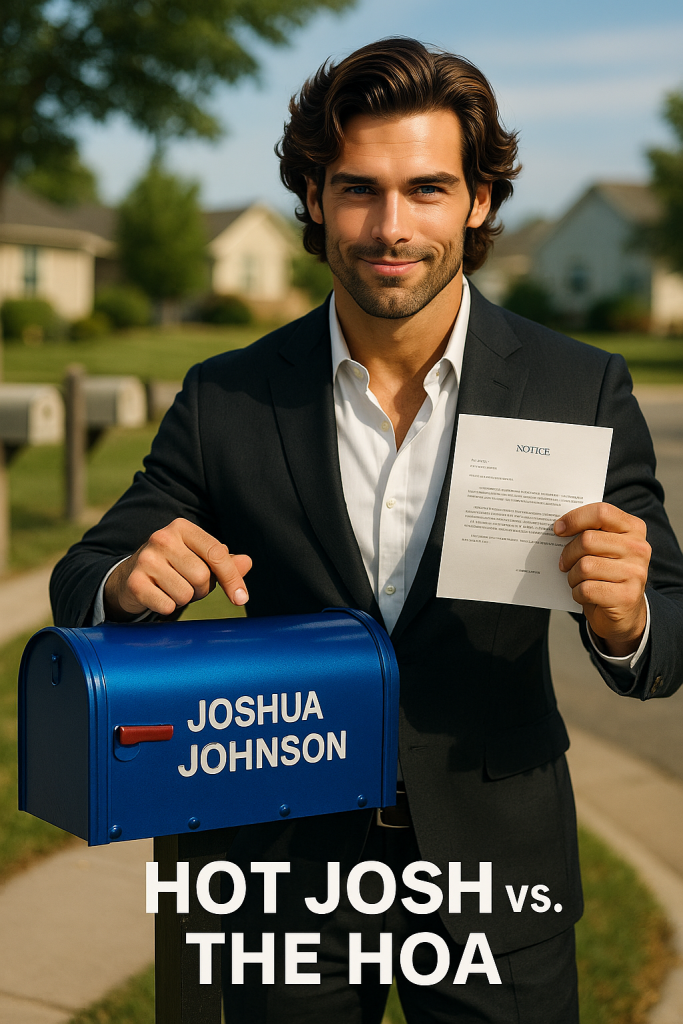
Because on the Fourth of July, even the law knows—you don’t mess with Hot Josh’s freedom.

That Time I Demanded a Refund for Finishing My Meal

So I’m at this upscale steakhouse, right? I ordered the filet with garlic butter—medium rare, obviously—and a glass of cabernet because I’m classy.

Everything arrives. It looks amazing. I clean my plate. Not a speck left. The wine? Gone. The butter? Basically a memory.

Then I ask the waiter to come over, fold my arms, and say, “I’m going to need a refund.”

He looks confused, as if this is somehow my fault.

“But… you ate all of it?”

“Correct,” I reply. “And while the taste was technically fine, I didn’t feel seen as a customer. The lighting was harsh, the music wasn’t curated to my inner journey, and the server never once told me I looked stunning. So yes, I ate the meal. But I did not enjoy it on a soul level.”

He offers me a free dessert.

I scoff. “I’m not here for sugar. I’m here for justice.”

Manager comes. I repeat my concerns—this time louder so nearby tables understand the bravery unfolding before them. He won’t comp the meal, so I leave a one-star review about the “emotional neglect baked into their business model” and vow never to return.

I actually went back three days later. But I wore sunglasses so they wouldn’t recognize me.

“I Deserve a Raise for Showing Up (Eventually)”

So it’s Monday morning. I stroll into work—10:52 AM, which in my opinion is basically still morning—and my manager has the audacity to give me a look. Like, “You’re late again.”

I calmly explained that traffic was “spiritual” today and I needed to honor the journey. Then I asked if I could speak to her privately. She looked nervous. Good. That meant I had the upper hand.

I sat her down and said, “I think it’s time we discuss a raise.”

She blinked like I had just recited a spell. “A… raise?”

“Yes,” I said. “Despite overwhelming odds—alarm clocks, construction zones, my own lack of motivation—I still find the strength to show up. And that’s not nothing.”

She had the nerve to say, “But you’re consistently two hours late and have been written up three times this month.”

So I clarified: “That’s why I deserve hazard pay. For enduring this toxic environment of micromanagement and punctuality obsession.”

Long story short, I didn’t get the raise. But I did get an extra 10-minute break for my mental health, which I immediately used to leave early.

We call that entitled progress.