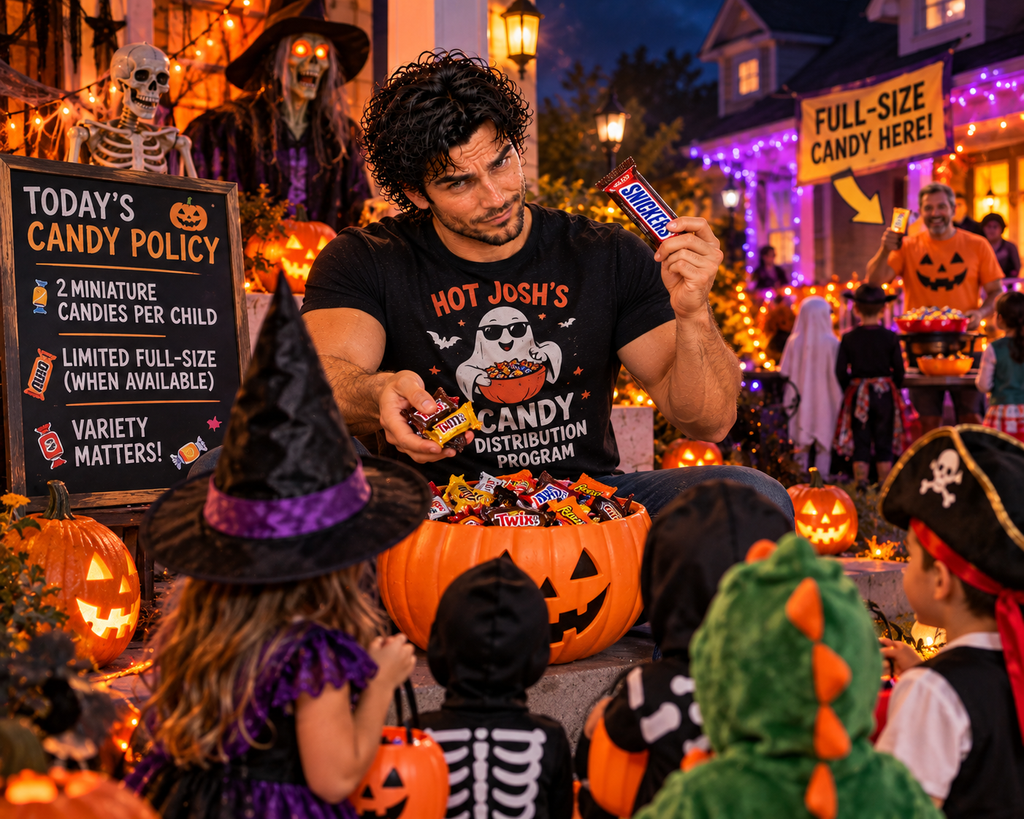
Hot Josh and the Halloween Candy Redistribution Program
Halloween.
My favorite holiday.
Not because of the costumes.
Not because of the decorations.
Not even because of the opportunity to watch grown adults spend hundreds of dollars making their houses look abandoned.
No.
Halloween is special because it’s the one night of the year when society collectively agrees that strangers should distribute free merchandise to people who knock on their doors.
An extraordinary business model.
No purchase necessary.
No loyalty program.
No subscription.
Just show up.
Request candy.
Receive candy.
Beautiful.
Naturally, I had concerns about how the program was being administered.
It started at 5:47 p.m.
I was standing on my front porch admiring my Halloween decorations.
Fog machine.
Orange lights.
Three skeletons.
A giant inflatable pumpkin.
And a motion-activated witch that screamed every time somebody walked past.
Excellent.
I’d spent $286 transforming my front yard into a temporary supernatural attraction.
Worth every penny.
Then I noticed something across the street.
My neighbor was handing out full-size candy bars.
Full.
Size.
Not the tiny ones.
Not the individually wrapped pieces that require six servings to equal one respectable chocolate bar.
Actual full-size candy.
I watched a child approach.
“Trick or treat!”
My neighbor smiled.
Handed over a full-size chocolate bar.
The child gasped.
Understandable.
Then another child approached.
Another full-size bar.
Then another.
And another.
I stood there.
Processing.
My own candy bowl contained miniature chocolates.
Perfectly good miniature chocolates.
But miniature nonetheless.
Suddenly, my entire Halloween operation looked underfunded.
I walked across the street.
“Good evening.”
My neighbor smiled.
“Hey, Josh! Happy Halloween!”
“Happy Halloween.”
I looked at the candy bowl.
Then at him.
Then back at the candy bowl.
“Full-size bars?”
“Yep!”
“Interesting.”
He smiled.
“Kids love them.”
“Of course they do.”
I folded my arms.
“Have you considered the economic consequences?”
He blinked.
“What?”
“The economic consequences.”
“Of candy?”
“Of distributing premium merchandise without coordinating with neighboring providers.”
He laughed.
“Josh, it’s Halloween.”
“Exactly. A highly competitive seasonal marketplace.”
He stared at me.
I continued.
“You’re establishing unrealistic consumer expectations.”
He laughed harder.
“How?”
“Children leave your house with a full-size candy bar.”
“Right.”
“Then they come to my house.”
“Okay.”
“And receive a miniature.”
He nodded.
“So?”
“So now my customer satisfaction ratings are in jeopardy.”
He nearly dropped the bowl laughing.
“You’re ridiculous.”
“That’s not a denial.”
I returned home.
Looked at my candy.
Then at his candy.
Then at mine again.
This was unacceptable.
I needed a strategy.
At 6:12, I implemented a new distribution policy.
TWO MINIATURE CANDIES PER CHILD.
Generous.
Competitive.
Financially responsible.
The first group approached.
Four children.
A pirate.
A princess.
A dinosaur.
And something that appeared to be a haunted refrigerator.
I admired the creativity.
“Trick or treat!”
I smiled.
“Happy Halloween!”
I handed each child two candies.
The pirate looked inside his bag.
Then looked at me.
“Only two?”
I froze.
Only?
ONLY?
I leaned forward.
“Excuse me?”
He pointed across the street.
“That house gives big candy bars.”
There it was.
Market disruption.
I knew this would happen.
I smiled.
“Yes, but we offer a diversified candy portfolio.”
The pirate stared.
“What?”
“Two different varieties.”
He looked at his candy.
Then at me.
Then at his mother.
His mother was laughing.
I continued.
“Some houses specialize in quantity. Others focus on variety.”
The dinosaur interrupted.
“Can I have another?”
I looked at him.
“Have you completed the customer satisfaction survey?”
His mother laughed even harder.
The dinosaur looked confused.
I handed him another candy.
“Consider that a promotional bonus.”
The group left.
I returned to my porch chair.
And began evaluating my position.
By 6:45, I’d distributed forty-seven pieces of candy.
Across the street, my neighbor continued handing out full-size bars.
Children were literally running toward his house.
Running.
Meanwhile, several approached mine at a leisurely pace.
One actually skipped my driveway.
Skipped it.
I watched in disbelief.
Apparently brand loyalty was dead.
At 7:03, I decided to conduct a competitive analysis.
I crossed the street again.
My neighbor saw me coming.
“Oh, here we go.”
I smiled.
“Quick question.”
He laughed.
“Of course.”
“How many candy bars have you distributed?”
“I don’t know. Maybe seventy?”
Seventy.
Full-size.
I mentally calculated the expense.
“What’s your cost per customer?”
He stared.
“My what?”
“Cost per customer.”
“Josh, I bought candy at the store.”
“Without a budget?”
He laughed.
“Without a spreadsheet, yes.”
Reckless.
Absolutely reckless.
I looked at his candy bowl.
Then at him.
“Are you accepting adults?”
He raised an eyebrow.
“Adults?”
“For candy.”
He laughed.
“Sure. Why not?”
Excellent.
I extended my hand.
“Trick or treat.”
He stared at me.
Then burst out laughing.
“You’re serious?”
“Completely.”
He handed me a full-size chocolate bar.
Victory.
I examined it.
Perfect.
Unopened.
Premium quality.
Then I returned to my house.
And immediately placed the candy bar in my own bowl.
I had acquired competitive inventory.
At 7:19, a little girl dressed as a witch approached.
“Trick or treat!”
I smiled.
“Happy Halloween!”
She looked at the bowl.
Saw the full-size candy bar.
And gasped.
“Can I have that one?”
I looked at the bar.
Then at her.
Then at the bar.
This was a difficult moment.
My only full-size item.
My flagship product.
My competitive advantage.
I considered explaining that it was display merchandise.
Then I looked at her costume.
Pointed hat.
Purple cape.
A broom almost as tall as she was.
She had clearly put effort into the occasion.
I handed her the candy bar.
Her face lit up.
“REALLY?”
I nodded.
“Really.”
“THANK YOU!”
She ran toward her parents.
Holding the candy bar over her head like she’d won an Olympic medal.
Her mother smiled and waved.
I waved back.
And something strange happened.
I felt good.
Not the usual good that comes from getting something for free.
Not the satisfaction of winning an argument.
Not even the thrill of securing a complimentary upgrade.
Something different.
I had given away the best thing I had.
And somehow, that felt better than keeping it.
Disturbing.
Very disturbing.
At 7:42, I noticed an older gentleman walking slowly down the sidewalk.
He wasn’t wearing a costume.
He wasn’t carrying a candy bag.
He was simply enjoying the decorations.
He stopped to admire my giant pumpkin.
“Looks great!”
“Thank you.”
He smiled.
“Quite a display.”
I nodded proudly.
“Two hundred eighty-six dollars.”
He laughed.
“Well, it looks like you got your money’s worth.”
I looked at my candy bowl.
Then at him.
“Would you like some candy?”
He smiled.
“Oh, no. That’s for the kids.”
I shrugged.
“You’re somebody’s kid.”
He laughed.
“Well, I suppose that’s true.”
I handed him a chocolate.
He thanked me.
And continued walking.
Another successful transaction.
No revenue.
No profit.
No complaint.
This Halloween business model was beginning to make sense.
At 8:15, trick-or-treating was winding down.
The streets grew quieter.
The fog machine sputtered.
The inflatable pumpkin leaned slightly to the left.
And my motion-activated witch had screamed so many times that I was beginning to question her commitment to customer service.
I looked into my candy bowl.
Six pieces remained.
Six.
I considered keeping them.
After all, I’d paid for them.
Then I noticed a little boy approaching with his father.
The boy wore a homemade robot costume.
Cardboard boxes.
Silver paint.
A collection of buttons drawn on with markers.
His father carried a flashlight.
The boy walked up.
“Trick or treat!”
I smiled.
“Happy Halloween!”
He held out his bag.
I looked at the six remaining candies.
Then at him.
Then back at the bowl.
I dumped all six into his bag.
His eyes widened.
“ALL OF THEM?”
“All of them.”
He looked at his father.
“DAD! HE GAVE ME SIX!”
His father laughed.
“Well, that was nice!”
I nodded.
“End-of-season inventory liquidation.”
The father laughed.
The boy didn’t understand.
He didn’t need to.
He was too busy celebrating.
As they walked away, I looked across the street.
My neighbor was packing up his decorations.
He waved.
“How’d business go?”
I smiled.
“Excellent.”
“Run out of candy?”
“Completely.”
He laughed.
“Good!”
I walked across the street one final time.
He looked at me suspiciously.
“What now?”
I smiled.
“I wanted to thank you.”
He blinked.
“For what?”
“For the competitive pressure.”
He laughed.
“You’re welcome?”
I nodded.
“You forced me to reevaluate my distribution strategy.”
“Glad I could help.”
“And I learned something.”
He raised an eyebrow.
“Oh, really?”
“Yes.”
I looked toward the sidewalk where the robot had disappeared.
“Apparently giving away candy is more enjoyable than trying to control how much everybody else gives away.”
He smiled.
“That’s kind of the point of Halloween.”
I nodded.
“Interesting.”
Then I held out my hand.
He looked at it.
“What?”
“One more question.”
He sighed.
“Of course.”
“Any full-size bars left?”
He burst out laughing.
“JOSH!”
“What?”
“GO HOME!”
I laughed.
And did.
The lesson?
Hot Josh believes Halloween should provide equal candy opportunities for everyone.
But sometimes the best part of getting something for free is realizing how much better it feels to give something away.
Although, for the record, the house across the street is still creating an unfair competitive advantage.
And next year, I’m bringing a spreadsheet.